
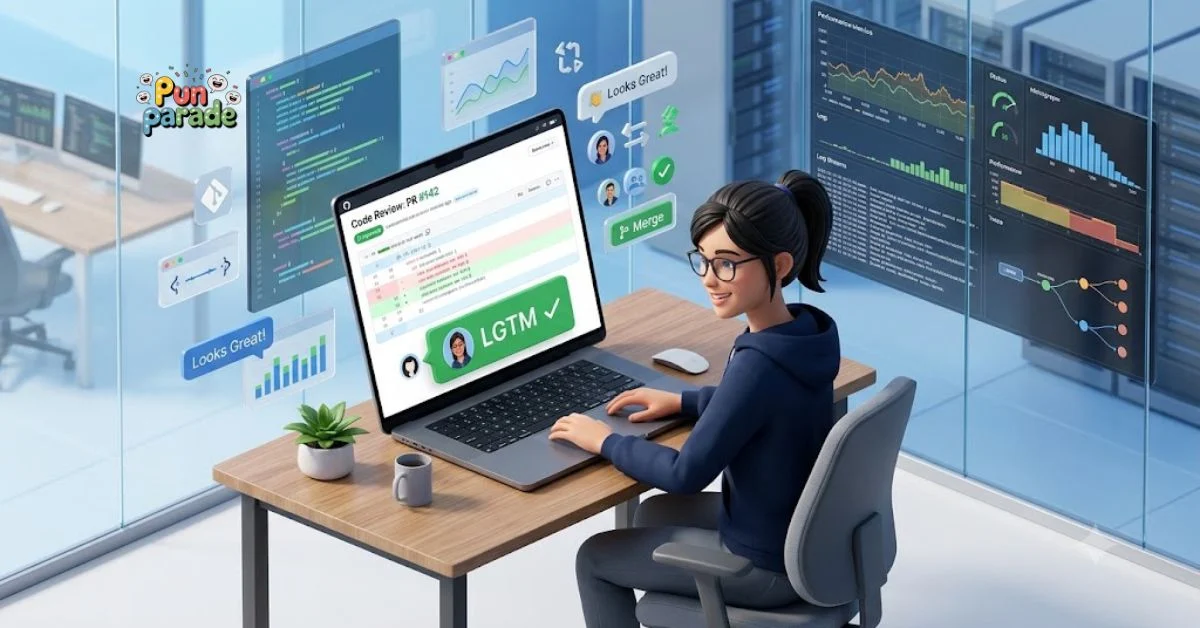
Have you ever seen someone reply with “LGTM” in a GitHub pull request, Slack message, or even a casual chat and wondered what they meant?
At first glance, it looks like just another internet abbreviation. But once you understand it, you’ll notice it’s one of the most common expressions used by developers, software teams, and even online communities.
LGTM usually means “Looks Good To Me.” It’s a quick way to show approval after reviewing something. Whether it’s a piece of code, a design, a document, or even a funny meme, the phrase tells the other person that everything appears acceptable.
People search for the meaning of LGTM because they see it in different places—GitHub reviews, software discussions, Grafana documentation, programming forums, Discord servers, and workplace chats. The context can slightly change its tone, but the core meaning remains the same: approval after checking something.
In this guide, you’ll learn where LGTM came from, why developers love using it, how it appears in different online communities, and how to respond naturally when someone sends it.
LGTM Meaning – Quick Meaning
LGTM stands for:
“Looks Good To Me.”
It simply means:
- I reviewed it.
- I approve it.
- I don’t see any problems.
- You can move forward.
Although it started in software development, people now use it in many online conversations whenever they want to express approval quickly.
Examples
“I checked your pull request. LGTM!“
“Your presentation slides are ready. LGTM.“
“That vacation plan? LGTM! Let’s book it.“
Origin & Background
LGTM became popular inside software engineering communities long before it spread across the wider internet.
When developers collaborate on projects, they review each other’s code before adding it to the main project. Instead of writing a long message like:
“I’ve reviewed everything, and I don’t see any issues.”
they simply type:
LGTM
The abbreviation became especially common on GitHub, GitLab, Bitbucket, and other code review platforms because it saves time while clearly communicating approval.
Over time, programmers started using it in Slack, Discord, Reddit, and workplace chats. Eventually, even people outside software development adopted it as a playful way of saying “approved.”
Today, LGTM isn’t limited to coding. You’ll find it in:
- Team collaboration apps
- Project management discussions
- Social media comments
- Tech communities
- Online gaming groups
- Workplace messaging platforms
Its popularity reflects a larger trend in digital communication: people prefer short, efficient expressions that still convey clear meaning.
Read More: TW Meaning in Chat: What It Really Means on Text, Snapchat, TikTok & Instagram
LGTM Meaning in Software
In software development, LGTM usually means that a reviewer has examined someone’s code and believes it is ready to merge.
It does not always mean the code is perfect.
Instead, it usually means:
- No obvious bugs were found.
- Coding standards were followed.
- The reviewer is satisfied.
- The changes can move to the next step.
Many development teams even have informal rules where a pull request cannot be merged until one or more reviewers reply with LGTM.
LGTM Meaning on GitHub
GitHub is probably where most people first encounter the term.
Imagine a developer submits a pull request containing new features.
Another developer reviews the code and comments:
LGTM 👍
That simple reply tells everyone reviewing the project:
- The code has been checked.
- No significant issues remain.
- The reviewer approves merging it.
Some teams combine LGTM with suggestions:
“LGTM after fixing the typo.”
or
“Almost LGTM—just update the documentation.”
In these cases, approval is conditional rather than immediate.
LGTM Meaning in Grafana
If you’ve explored Grafana documentation or observability discussions, you’ve probably seen LGTM used in another interesting way.
Within the Grafana ecosystem, LGTM also represents four major open-source observability tools:
- Loki
- Grafana
- Tempo
- Mimir
Together, these tools help developers monitor applications by collecting:
- Logs
- Metrics
- Traces
- Dashboards
Because of this, people sometimes search for LGTM meaning Grafana or LGTM meaning observability, expecting the usual abbreviation but discovering a completely different technical acronym.
The intended meaning depends entirely on the conversation.
LGTM Meaning in Observability
In modern cloud infrastructure, observability refers to understanding how software systems behave.
The LGTM stack combines:
- Loki for logs
- Grafana for visualization
- Tempo for distributed tracing
- Mimir for metrics
Here, LGTM isn’t an approval phrase at all—it’s simply the initials of four connected technologies that work together.
This is why context matters.
A developer reviewing code probably means:
“Looks Good To Me.”
A cloud engineer discussing monitoring tools may instead mean the LGTM observability stack.
See Also: I Love You: Meaning, Emotional Depth, Creative Ways to Say It & When It Matters Most
LGTM Meaning in R Programming
R programmers occasionally use LGTM just like developers in other programming languages.
For example, after reviewing statistical code or data analysis scripts, a teammate might write:
“LGTM—nice work.”
The phrase itself doesn’t belong specifically to the R language. Instead, it’s part of the broader programming culture shared across Python, JavaScript, Java, C++, Go, Rust, and many other development communities.
Real-Life Conversations
Person A:
I updated the project report. Can you check it?
Person B:
Just finished reading it. LGTM. Send it to the client.
Instagram DM
Person A:
I’m thinking of posting this photo.
Person B:
Honestly… LGTM! Go for it.
TikTok Comments
Creator:
Rate my room makeover.
Commenter:
LGTM! The lighting completely changed the vibe.
Text Messages
Person A:
Here’s the itinerary for our road trip.
Person B:
LGTM. I’ll book the hotel tonight.
Emotional & Psychological Meaning
Although LGTM is only four letters, it carries a positive emotional message. It tells someone, “I trust your work,” “I approve,” or “You can move forward.” In fast-paced online communication, this brief response can provide reassurance without requiring a lengthy explanation.
People often use LGTM because it saves time while still showing support. Instead of writing a detailed review every time, they can quickly acknowledge that they’ve checked something and are satisfied with it.
From a psychological perspective, receiving an LGTM feels like getting a green light. It reduces uncertainty and gives the other person confidence to continue.
A Personal-Style Scenario
I once worked with a team where every project update required peer review. Seeing a simple “LGTM” from a teammate after hours of editing always brought a sense of relief. It wasn’t just an approval—it meant someone had carefully reviewed the work and believed it was ready.
Usage in Different Contexts
Social Media
On platforms like Reddit, Discord, X, and Instagram, LGTM is often used to approve photos, videos, memes, or creative ideas.
Example:
“Your new profile picture? LGTM!”
Friends & Relationships
Friends sometimes use LGTM when giving opinions about outfits, travel plans, or personal decisions.
Example:
“I finally picked this birthday gift.”
“LGTM—you should buy it.”
Work & Professional Settings
In workplaces, LGTM is widely used during document reviews, design approvals, presentations, and software development.
Instead of writing lengthy confirmations, colleagues simply respond with LGTM to indicate they’re satisfied.
Software Development
Developers frequently use LGTM during code reviews before merging changes into a project.
It signals that the reviewer doesn’t see any major issues.
Casual vs. Serious Tone
In casual conversations, LGTM feels friendly and relaxed.
In professional settings, it’s concise and efficient.
However, in formal business communication with clients or executives, writing a complete sentence such as “Everything looks good to me.” is usually more appropriate.
When NOT to Use It
Although LGTM is helpful, it doesn’t fit every situation.
Avoid using it when:
- The document hasn’t actually been reviewed.
- Detailed feedback is expected.
- Speaking with someone unfamiliar with internet abbreviations.
- Writing formal emails to clients or senior management.
- Discussing legal, medical, or financial documents where precise communication matters.
Using LGTM without checking the content can create misunderstandings and reduce trust.
Common Misunderstandings
One common misconception is that LGTM guarantees perfection.
It doesn’t.
It simply means the reviewer didn’t find any significant problems during their review.
Another misunderstanding comes from the Grafana community, where LGTM refers to a group of observability tools rather than “Looks Good To Me.”
Some beginners also mistake LGTM for LGT, assuming they’re the same abbreviation. In most online conversations, however, LGTM is the widely recognized expression for approval.
Tone can also be confusing. Depending on the context, LGTM may be sincere, enthusiastic, neutral, or even slightly sarcastic if someone intentionally uses it after pointing out obvious mistakes.
Comparison Table
| Expression | Meaning | Typical Use | Tone |
|---|---|---|---|
| LGTM | Looks Good To Me | Code reviews, approvals, chats | Positive |
| Approved | Official acceptance | Work and business | Formal |
| Sounds good | Agreement with an idea | Everyday conversations | Friendly |
| Looks great | Strong praise | Creative work | Enthusiastic |
| Ship it | Ready to release | Software development | Excited |
| Needs changes | Revision required | Reviews | Constructive |
| Rejected | Not approved | Formal review | Negative |
| LGT | Less common abbreviation | Rare online usage | Neutral |
Key Insight
LGTM is unique because it combines approval with efficiency. It communicates trust in just four letters, making it especially popular in collaborative environments where quick decisions matter.
Variations / Types of LGTM
Here are some common variations and related expressions you may come across online, especially in software development and digital communication.
1. LGTM 👍
Meaning: Looks Good To Me with added enthusiasm.
The thumbs-up emoji reinforces approval and positivity.
2. LGTM 🚀
Meaning: Approved and ready to launch.
Developers often use this when code is ready to be merged or released.
3. LGTM, Thanks!
Meaning: Approval with appreciation.
A polite way to acknowledge someone’s effort after reviewing their work.
4. LGTM After One Small Change
Meaning: Mostly approved, but a minor fix is needed.
Common in code reviews and document editing.
5. Almost LGTM
Meaning: Very close to approval.
A few small improvements are required before it’s fully accepted.
6. LGTM +1
Meaning: I agree with the previous approval.
Frequently seen when multiple reviewers are involved.
7. LGTM with Comments
Meaning: Approved, but additional suggestions have been shared.
The feedback is optional rather than mandatory.
8. Ship It!
Meaning: Everything looks ready for release.
A popular phrase among software teams after a successful review.
9. Approved
Meaning: A more formal alternative to LGTM.
Often used in workplaces, business documents, and official reviews.
10. Looks Great!
Meaning: Stronger praise than LGTM.
It highlights both approval and appreciation for the quality of the work.
Related Posts: Quality Over Quantity: Why Choosing Better Matters More Than Having More
How to Respond When Someone Uses LGTM
If someone replies with LGTM, they’re usually letting you know they approve of your work. Here are some natural ways to respond.
Casual Replies
- Thanks!
- Awesome, appreciate it!
- Great, I’ll move forward.
- Glad you liked it!
- Perfect, thanks for checking.
Funny Replies
- Success unlocked! 🎉
- Green light received!
- Time to hit merge. 😄
- Mission accomplished!
- Coffee’s on me now.
Mature Replies
- Thank you for taking the time to review it.
- I appreciate your feedback and approval.
- Thanks for confirming everything looks good.
- I’ll proceed with the next step.
Respectful Replies
- Thank you for reviewing it carefully.
- I appreciate your support.
- Thanks for your approval.
- I’ll keep your feedback in mind going forward.
Regional & Cultural Usage
Western Culture
In North America and Europe, LGTM is widely recognized among software developers, engineers, designers, and technology professionals. It’s a standard part of code review culture and workplace communication.
Asian Culture
Many technology companies across Asia use LGTM in international teams. However, outside the tech industry, people may not recognize the abbreviation, so writing the full phrase is often clearer.
Middle Eastern Culture
LGTM appears mainly in software companies, startups, and online developer communities. In formal business communication, complete sentences are generally preferred over abbreviations.
Global Internet Usage
Because platforms like GitHub, Slack, Discord, Reddit, and Stack Overflow connect users worldwide, LGTM has become part of the shared language of global tech communities.
Gen Z vs. Millennials
Gen Z tends to use LGTM alongside emojis, GIFs, and memes, making it feel more playful and informal.
Millennials often use it in professional settings, especially during project reviews, remote collaboration, and software development, where brevity and clarity are valued.
Is It Safe for Kids?
Yes. LGTM is generally considered a safe and harmless abbreviation. It simply means “Looks Good To Me” and expresses approval or agreement. Parents should still encourage children to understand the context in which abbreviations are used, but LGTM itself contains no offensive or inappropriate meaning.
FAQs
What does LGTM mean?
LGTM stands for “Looks Good To Me.” It’s commonly used to approve code, documents, designs, or ideas after reviewing them.
What does LGTM mean in software?
In software development, LGTM means a reviewer has checked the code and believes it’s ready to merge or move forward.
What does LGTM mean on GitHub?
On GitHub, LGTM is a common code review comment indicating that the reviewer approves the pull request and doesn’t see major issues.
What does LGTM mean in Grafana?
Within the Grafana ecosystem, LGTM refers to the Loki, Grafana, Tempo, and Mimir observability stack rather than the phrase “Looks Good To Me.”
What should I reply to LGTM?
Simple replies like “Thanks!”, “Appreciate the review,” or “Great, I’ll proceed” are natural and appropriate.
Is LGTM only used by programmers?
No. While it originated in software development, people now use LGTM in workplace chats, online communities, and casual conversations whenever they want to express approval.
Is LGTM the same as LGT?
No. LGTM is the widely accepted abbreviation for “Looks Good To Me.” LGT is much less common and may have different meanings depending on the context.
What is LGT in chat?
LGT is a less common abbreviation and can have different meanings depending on the context. Most people actually mean LGTM, which stands for “Looks Good To Me.”
Is it OK to say LGTM?
Yes, LGTM is widely accepted in software development and workplace chats to show you’ve reviewed and approved something. It works best in informal or team communication.
Is LGTM a good response?
Yes, LGTM is a concise and professional way to approve code, documents, or ideas after reviewing them. It clearly signals that you’re satisfied with the result.
What is LGTM in code review?
In code review, LGTM means “Looks Good To Me,” indicating the reviewer found no major issues. It usually means the code is ready to be merged or moved to the next step.
Conclusion
LGTM may be a short abbreviation, but it has become an important part of modern digital communication. Whether you’re reviewing code on GitHub, discussing the LGTM observability stack in Grafana, or simply approving a friend’s idea in a chat, the meaning depends on the context—but it almost always signals confidence and approval.
Understanding LGTM helps you communicate more naturally in professional and online environments. Once you recognize when and where to use it, you’ll find it to be a simple yet effective way to acknowledge good work, encourage collaboration, and keep conversations moving smoothly.
