
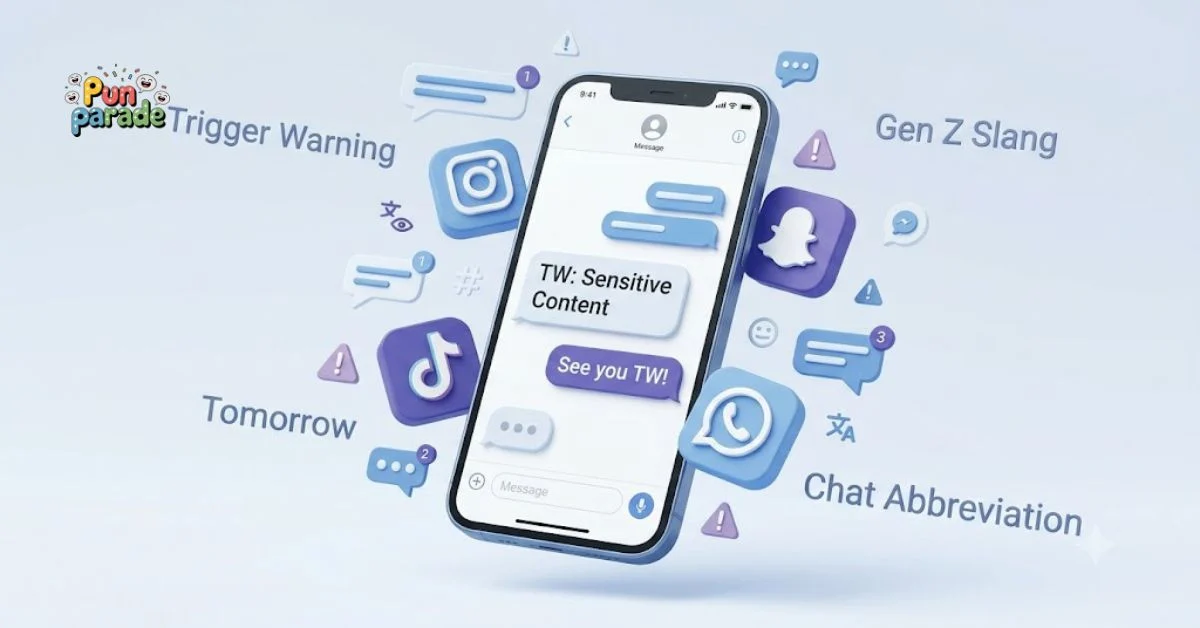
If you’ve been scrolling through TikTok, reading Instagram comments, or chatting with friends, you’ve probably come across the abbreviation TW and wondered what it actually means. The answer isn’t always straightforward because TW has more than one meaning, depending on where it’s used and who is using it.
Many people search for TW meaning in chat, TW meaning in Instagram, TW meaning Snapchat, or even TW meaning in Pakistan because the abbreviation appears in very different contexts. Sometimes it’s a serious warning before sensitive content, while other times it can simply refer to tomorrow or another casual abbreviation in texting.
This guide explains every common meaning of TW, shows how people use it in real conversations, and helps you understand when it’s appropriate to use—and when it might cause confusion.
TW Meaning in Chat – Quick Meaning
In online chats, TW most commonly stands for Trigger Warning. It alerts readers that the following message, photo, or video may contain content that could be upsetting or emotionally difficult.
However, in casual texting, some people also use TW as a short form for tomorrow, although this is much less common.
Quick meanings of TW
- Trigger Warning (most common)
- Tomorrow (informal texting)
- A context-specific abbreviation in gaming, school, or work groups
- Occasionally mistaken for other internet slang
Examples
“TW: Graphic injury photos ahead.”
“TW: Discussion about anxiety and depression.”
“I’ll send you the notes TW.”
The first two examples use TW as Trigger Warning, while the last example uses it to mean tomorrow.
Origin & Background
The abbreviation TW became popular on internet forums and blogging platforms during the early 2000s. Writers began placing “Trigger Warning” before posts discussing topics like violence, abuse, eating disorders, or traumatic experiences.
The purpose wasn’t to censor conversations. Instead, it gave readers a chance to prepare emotionally or decide whether they wanted to continue reading.
As social media platforms grew, the abbreviation spread quickly.
Users on TikTok, Instagram, Reddit, Snapchat, and X started adding TW before videos, captions, or comment threads discussing sensitive topics.
Over time, younger internet users also adopted the abbreviation in everyday conversations, making it a familiar part of online communication.
In some texting communities, especially among friends, TW also appeared as shorthand for tomorrow, though this meaning never became as widespread as Trigger Warning.
See Also: Thank You for Your Understanding: Meaning, Professional Uses, Examples & Better Alternatives
Why social media made TW popular
Social media encourages quick communication.
Instead of writing “This post contains sensitive content,” users simply write:
TW: Violence
or
TW: Blood
The abbreviation saves space while communicating an important message.
TW Meaning in Pakistan
In Pakistan, most English-speaking social media users understand TW to mean Trigger Warning, especially on Instagram, TikTok, Reddit, and X.
However, among friends chatting through WhatsApp or Messenger, some people may use TW as shorthand for tomorrow, particularly if everyone in the conversation already understands the context.
Because both meanings exist, it’s always best to read the entire conversation before deciding what TW means.
TW Meaning in Urdu
When TW means Trigger Warning, it can be understood in Urdu as:
“حساس مواد کی پیشگی اطلاع”
or
“انتباہ کہ آگے حساس یا پریشان کن مواد موجود ہے۔”
If TW means tomorrow, then the Urdu meaning is simply:
“کل”
The intended meaning depends entirely on the conversation.
Real-Life Conversations
Understanding TW becomes much easier when you see it used in everyday conversations. Here are realistic examples from different platforms.
1. WhatsApp Chat
Person A: I wanted to share something that happened last year. TW: family loss.
Person B: Thanks for the warning. I’ll read it when I’m in the right headspace.
2. Instagram DMs
Person A: Did you watch her latest story?
Person B: Yes. She added TW: eating disorder discussion before the video.
Person A: I appreciated that. It helped me decide when to watch it.
3. TikTok Comments
Creator: TW: Flashing lights and loud sounds.
Commenter 1: Thanks for adding the warning!
Commenter 2: I have migraines, so this really helps.
4. Text Messages
Person A: Are we meeting TW?
Person B: Yes, around 5 PM. I’ll text you before I leave.
In this example, TW means tomorrow, not Trigger Warning. The surrounding conversation makes the meaning clear.
Emotional & Psychological Meaning
Although TW is only two letters, it carries a thoughtful message. When someone uses TW as Trigger Warning, they’re showing consideration for other people’s emotional well-being.
It tells readers, “The next part may be difficult. Please continue only if you’re comfortable.”
In today’s digital world, people often share deeply personal stories about grief, trauma, mental health, or recovery. A simple warning allows others to prepare emotionally instead of being caught off guard.
Using TW doesn’t mean a topic should never be discussed. Instead, it encourages respectful communication and gives readers a choice.
Why People Use It
People use TW because they want to:
- Show empathy toward others.
- Respect different emotional experiences.
- Help readers avoid unexpected distress.
- Create safer online conversations.
- Encourage informed choices before viewing sensitive content.
A Real-Life Scenario
Imagine a university student scrolling through Instagram during a stressful exam week. They unexpectedly come across a detailed post about a serious accident. Without any warning, the content could be upsetting.
If the post begins with “TW: Accident and injuries,” the student can decide whether to continue reading later when they feel emotionally ready.
This small act of consideration makes online communication more respectful and thoughtful.
Usage in Different Contexts
The meaning of TW changes depending on where it’s used.
1. Social Media
This is where TW most often means Trigger Warning.
People place it before:
- Mental health discussions
- Violence
- Blood or injuries
- Abuse stories
- Eating disorder recovery
- Grief or loss
Examples:
- TW: Violence
- TW: Self-harm discussion
- TW: Flashing lights
Its purpose is to inform—not to discourage conversation.
2. Friends & Relationships
Friends may use TW before sharing personal experiences.
Examples include:
- “TW: Anxiety.”
- “TW: Breakup story.”
- “TW: Family issues.”
This shows care for the other person’s feelings and creates a more supportive conversation.
3. Work & Professional Settings
In professional communication, TW is much less common.
Instead of using the abbreviation alone, people usually write the full phrase:
- Content Warning
- Sensitive Content
- This presentation includes graphic images.
Using complete wording helps avoid confusion and sounds more formal.
4. Casual Texting
In some friend groups, TW simply means tomorrow.
Example:
A: Movie TW?
B: Sounds good!
However, because this usage is less common than Trigger Warning, it’s best to use it only when everyone understands the abbreviation.
Casual vs. Serious Tone
Casual
- Meet TW?
- See you TW.
- Homework TW?
These examples are short, friendly, and rely on shared understanding.
Serious
- TW: Discussion of depression.
- TW: Graphic injury photos.
- TW: Domestic violence.
Here, TW serves an important purpose by preparing readers for potentially distressing content.
The tone is respectful and considerate rather than casual, making it an essential part of responsible online communication.
Read More: Sup Meaning in Chat: What It Really Means in Texts, Social Media & Everyday Conversations
When NOT to Use TW
Although TW is widely recognized online, it isn’t appropriate in every situation. Using it incorrectly can confuse readers or reduce the importance of genuine content warnings.
1. In Formal Business Communication
Avoid using TW in professional emails, reports, or workplace presentations unless you’re discussing genuinely sensitive material.
Instead, write:
- Content Warning
- Sensitive Material
- This presentation contains graphic images.
These phrases are clearer and more suitable for professional audiences.
2. As a Joke
Using TW for harmless or trivial situations can make real trigger warnings seem less meaningful.
For example:
❌ TW: I forgot my coffee today.
❌ TW: Monday morning.
While some friends may understand the humor, using TW this way can be insensitive to people who rely on genuine warnings before viewing difficult content.
3. When the Meaning Isn’t Clear
Some people still use TW to mean tomorrow.
For example:
Let’s meet TW.
Someone unfamiliar with this abbreviation might think you’re introducing sensitive content instead of talking about the next day.
If there’s any chance of confusion, simply write tomorrow instead.
4. With People Unfamiliar with Internet Slang
Not everyone spends time on social media or follows Gen Z language.
Older family members, teachers, clients, or international contacts may not understand what TW means.
In these situations, writing the full phrase is usually the better choice.
5. In Serious Discussions Without Context
A message that says only:
TW
doesn’t tell readers what to expect.
Instead, be specific.
Examples:
- TW: Violence
- TW: Grief
- TW: Eating disorder discussion
- TW: Graphic medical images
Providing context helps readers decide whether they want to continue.
Common Misunderstandings
Because TW has multiple meanings, misunderstandings happen quite often.
Here are the most common ones.
Mistaking Every TW for “Trigger Warning”
Some people assume TW always means Trigger Warning.
However, in certain text conversations, it may simply stand for tomorrow.
The surrounding message usually reveals the correct meaning.
Assuming It Means the Same Everywhere
The abbreviation isn’t used identically across every platform.
On TikTok and Instagram, TW almost always refers to Trigger Warning.
In private chats, however, it may have different meanings depending on the group.
Confusing TW with Other Warnings
People sometimes mix up:
- TW (Trigger Warning)
- CW (Content Warning)
- FW (Forwarded message in emails)
Although they’re related in some contexts, they don’t always mean the same thing.
Thinking TW Is Only for Mental Health Topics
While mental health discussions often include TW, it’s also used before content involving:
- Violence
- Blood
- Abuse
- Death
- Eating disorders
- Loud sounds
- Flashing lights
- Graphic accidents
The warning covers many different kinds of potentially distressing material.
Taking It Literally Every Time
If a friend texts:
See you TW.
They almost certainly mean tomorrow, not Trigger Warning.
Always read the entire conversation before deciding what the abbreviation means.
Comparison Table
| Expression | Meaning | Common Usage | Tone |
|---|---|---|---|
| TW | Trigger Warning or Tomorrow | Social media, texting | Depends on context |
| CW | Content Warning | Blogs, forums, social media | Informative |
| FYI | For Your Information | Work and casual chats | Neutral |
| BTW | By The Way | Everyday conversations | Casual |
| IDK | I Don’t Know | Texting and chat | Informal |
| BRB | Be Right Back | Live chats and gaming | Casual |
| Tomorrow | The next day | Everyday communication | Clear and universal |
| No Warning | Direct sharing of content | General communication | May surprise readers |
Key Insight
The meaning of TW depends entirely on context. On platforms like TikTok, Instagram, and Reddit, it almost always means Trigger Warning, while in some private chats it may mean tomorrow. Looking at the surrounding conversation is the easiest way to understand which meaning the sender intended.
Related Posts: BBL Meaning Slang: What It Really Means in Text, TikTok & Online Chats
Variations and Types of TW
While TW most often means Trigger Warning, you’ll occasionally see it used in other ways depending on the platform or conversation. Here are some common variations.
1. TW: Trigger Warning
The most widely recognized meaning online, used before sensitive or potentially distressing content.
Example: TW: Discussion of grief.
2. TW: Tomorrow
A shorthand used in some text messages and private chats to refer to the next day.
Example: Let’s meet TW after class.
3. TW: Violence
Many creators pair TW with a specific topic to warn viewers about graphic or disturbing content.
Example: TW: Violence.
4. TW: Blood or Injury
Used before photos or videos showing injuries, surgery, or blood.
Example: TW: Graphic injury images.
5. TW: Mental Health
Appears before discussions about depression, anxiety, panic attacks, or similar experiences.
Example: TW: Anxiety discussion.
6. TW: Eating Disorders
Common in recovery communities to prepare readers for sensitive conversations.
Example: TW: Eating disorder recovery.
7. TW: Abuse
Used before stories involving emotional, physical, or domestic abuse.
Example: TW: Domestic abuse.
8. TW: Death or Grief
Added before content about losing a loved one or discussing death.
Example: TW: Loss of a family member.
9. TW: Flashing Lights
Frequently seen on TikTok, YouTube, and Instagram before videos that may affect people with photosensitivity.
Example: TW: Flashing lights.
10. TW: Loud Sounds
Creators sometimes warn viewers about sudden screams, explosions, or other loud audio.
Example: TW: Loud noises.
How to Respond When Someone Uses TW
Your response should match both the meaning of TW and the tone of the conversation.
Casual Replies
- Thanks for the heads-up.
- Got it, I’ll check it out later.
- Appreciate the warning.
- I’ll read it when I have a moment.
Funny Replies
Use humor only if the topic is lighthearted and you know the other person well.
- Thanks for saving my scrolling mood!
- Good looking out!
- You always remember the warnings!
Avoid jokes if the TW relates to trauma, grief, or mental health.
Mature Replies
- Thank you for letting me know beforehand.
- I appreciate your consideration.
- I’ll read this when I’m emotionally ready.
- Thanks for being thoughtful.
Respectful Replies
- Thanks for including a trigger warning.
- I appreciate you thinking about your audience.
- I’ll take a look when I’m comfortable.
- Thank you for the advance notice.
If TW means tomorrow, simply reply naturally.
Examples:
- Sounds good. See you tomorrow!
- I’ll be there.
- Looking forward to it.
- See you then.
Regional & Cultural Usage
The interpretation of TW can vary across regions, cultures, and generations.
Western Culture
In countries like the United States, Canada, and the United Kingdom, TW is strongly associated with Trigger Warning. It’s commonly used on social media, blogs, podcasts, and online communities discussing sensitive topics.
Asian Culture
Across many Asian countries, including Pakistan, India, and the Philippines, younger internet users understand TW through exposure to global social media. On WhatsApp and private chats, however, some people may still use it as shorthand for tomorrow, making context especially important.
Middle Eastern Culture
English-speaking users in the Middle East generally recognize TW as Trigger Warning, particularly on international platforms like TikTok, Instagram, Reddit, and X. In everyday messaging, though, many people prefer writing the full word tomorrow to avoid confusion.
Global Internet Usage
Because social media connects people worldwide, TW has become a widely recognized abbreviation for Trigger Warning. Creators, influencers, journalists, and everyday users include it before content involving violence, grief, mental health, or other sensitive subjects to help audiences make informed viewing choices.
Gen Z vs. Millennials
Gen Z uses TW naturally in captions, comments, and short-form videos. They’re also more familiar with topic-specific warnings like TW: Flashing Lights or TW: Eating Disorders.
Millennials generally understand the abbreviation as well but may use it less frequently in everyday conversation. In professional or formal settings, many prefer writing out Trigger Warning or Content Warning in full for added clarity.
Is TW Safe for Kids?
Yes, TW itself is safe because it’s simply an abbreviation. In fact, when it stands for Trigger Warning, it can help children and teenagers avoid content that may be upsetting or inappropriate for their age.
However, parents and educators should remember that the warning is only a label. The content following a TW may discuss topics such as violence, self-harm, bullying, abuse, or grief. Younger users should be encouraged to read or watch such material with guidance when appropriate and to talk to a trusted adult if they have questions or feel distressed.
Frequently Asked Questions
What does TW mean in chat?
In most online chats, TW stands for Trigger Warning, which alerts readers that sensitive or potentially upsetting content follows. In some private text conversations, it can also mean tomorrow.
What does TW mean on Instagram?
On Instagram, TW almost always means Trigger Warning. Creators place it at the beginning of captions, Stories, or Reels to prepare viewers for sensitive topics.
What is the TW meaning on Snapchat?
On Snapchat, TW usually refers to Trigger Warning, especially in public Stories. In personal chats, a few users may use it as shorthand for tomorrow, depending on their friend group.
What does TW mean on TikTok?
On TikTok, TW is commonly used before videos that include topics like graphic injuries, mental health discussions, flashing lights, or emotional stories. It gives viewers the choice to continue watching or skip the content.
Does TW always mean Trigger Warning?
No. Although Trigger Warning is the most common meaning, TW can also stand for tomorrow in casual texting. The surrounding conversation usually makes the intended meaning clear.
What is the TW meaning in Urdu?
If TW means Trigger Warning, it can be understood as “حساس مواد کی پیشگی اطلاع” or “انتباہ برائے حساس مواد”. If it means tomorrow, the Urdu translation is simply “کل”.
Is TW a Gen Z slang term?
Not exactly. TW is better described as an internet abbreviation than traditional slang. While Gen Z uses it frequently on social media, people of many age groups recognize it because it’s widely used across online platforms.
What is TW on social media?
On social media, TW usually stands for Trigger Warning, alerting viewers that sensitive or potentially upsetting content follows. It commonly appears on TikTok, Instagram, X, and Reddit before topics like violence, grief, or mental health.
What did TW stand for?
TW originally became popular as an abbreviation for Trigger Warning in online forums and blogs. In some text messages, it can also mean tomorrow, depending on the context.
What is a TW girl?
A TW girl doesn’t have one universal meaning and isn’t a standard slang term. Online, it may refer to a girl discussing trigger-warning topics or be used in a community-specific context, so the meaning depends on the conversation.
Does TW mean two?
No, TW does not normally mean two in texting or social media slang. If someone wants to write the number two, they usually use 2 or spell out two instead.
Conclusion
The meaning of TW in chat depends on the conversation, but in today’s online world, it most commonly stands for Trigger Warning. Whether you’re browsing TikTok, reading Instagram captions, scrolling through Snapchat Stories, or joining online discussions, you’ll often see it used to let people know that sensitive content is coming next.
In some personal text messages, TW may also mean tomorrow, which is why context is so important. Looking at the rest of the conversation will usually make the intended meaning obvious.
Understanding abbreviations like TW helps you communicate more confidently and avoid misunderstandings. More importantly, recognizing when TW is used as a trigger warning encourages respectful, thoughtful interactions by giving others the opportunity to choose how and when they engage with sensitive content.
