
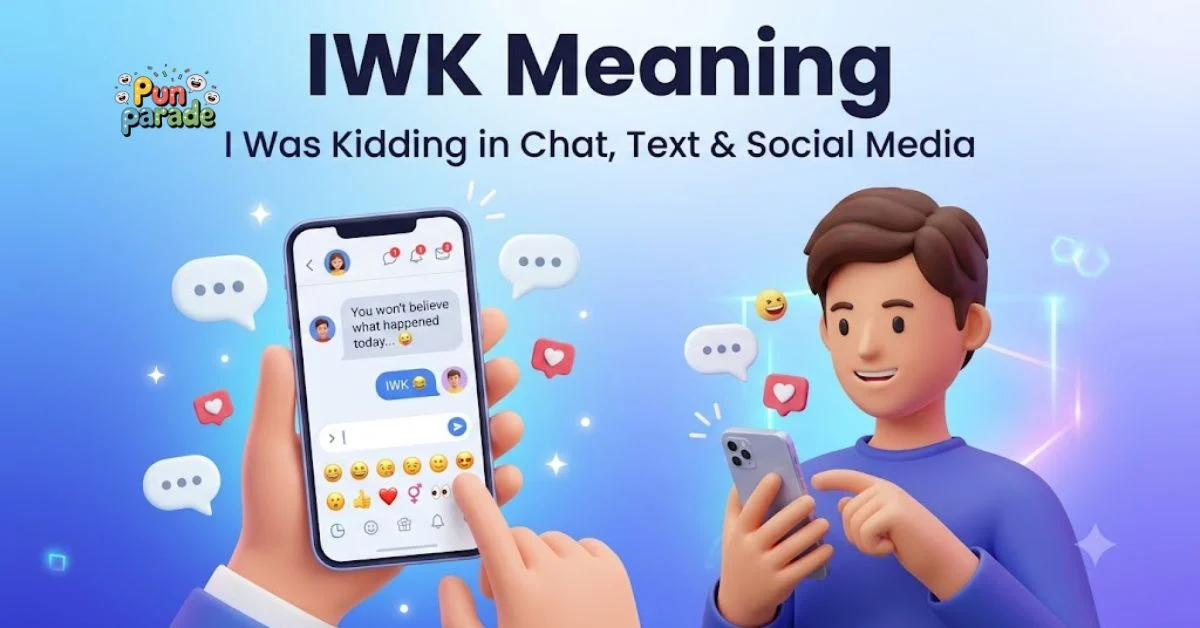
Have you ever received a message saying “IWK” and wondered what it meant? You’re not alone. Internet slang changes quickly, and abbreviations that seem obvious to one person can leave someone else completely confused.
The meaning of IWK depends on the conversation and the platform where it’s used. On apps like WhatsApp, Instagram, TikTok, Snapchat, and regular text messages, IWK most commonly means “I Was Kidding.” It’s a quick way to tell someone that a previous message was meant as a joke and shouldn’t be taken seriously.
In some online communities, people may use IWK differently, but “I Was Kidding” is by far the most recognized meaning in casual texting.
This guide explains what IWK means, where it came from, how people use it, when you should avoid it, and how to respond naturally.
IWK Meaning – Quick Meaning
IWK usually stands for:
- I Was Kidding
- Used after a joke, tease, or sarcastic comment
- Helps avoid misunderstandings in text conversations
- Common among Gen Z and younger millennials
Examples
“You’re paying for everyone’s dinner… IWK 😂”
“I said I hated your playlist. IWK.”
“Relax, IWK. I wasn’t being serious.”
In each example, the sender is letting the other person know that the previous statement wasn’t meant literally.
Origin & Background
Unlike older internet abbreviations such as LOL or BRB, IWK became more noticeable as texting became faster and conversations moved to social media.
Many people prefer typing short abbreviations instead of full sentences because they’re quicker and match the casual tone of online conversations.
As memes, sarcastic humor, and playful teasing became more popular on TikTok and Instagram, people needed an easy way to signal that they were joking. That’s where IWK fits perfectly.
Its popularity has grown because:
- People text faster than ever.
- Humor online is often dry or sarcastic.
- Tone is harder to understand through text.
- Short abbreviations save time.
Although IWK isn’t as common as LOL or IDC, it’s becoming more recognizable among younger internet users who frequently chat online.
Real-Life Conversations
WhatsApp Conversation
Person A: I deleted all our vacation photos.
Person B: Wait… seriously?
Person A: 😂 IWK. They’re backed up on my laptop.
Instagram DM
Person A: I think your selfie deserves zero likes.
Person B: Wow… rude.
Person A: Haha, IWK. It actually looks amazing.
TikTok Comments
Person A: This recipe belongs in the trash.
Person B: That’s harsh.
Person A: IWK 😂 I’d actually make it tomorrow.
Text Message
Person A: I forgot your birthday.
Person B: Seriously?
Person A: IWK! Your gift is already wrapped.
Read More: What Does MB Mean in Text? Simple Meanings, Examples, and When to Use It
Emotional & Psychological Meaning
At first glance, IWK simply means “I Was Kidding,” but it often carries a deeper emotional purpose. It helps people soften their words, repair misunderstandings, and reassure someone after a joke lands the wrong way.
In face-to-face conversations, a smile, laugh, or playful tone usually makes it obvious when someone is joking. Text messages don’t provide those nonverbal cues, so abbreviations like IWK help fill that gap.
People commonly use IWK to:
- Ease tension after teasing someone.
- Show they weren’t being serious.
- Keep conversations light and friendly.
- Prevent hurt feelings or arguments.
- Signal sarcasm without sounding mean.
A Real-Life Scenario
Imagine you jokingly text your best friend, “I’m never talking to you again.”
A few seconds later, you realize they haven’t replied. Instead of letting them worry, you send:
“IWK 😂”
That small abbreviation instantly changes the mood. What sounded harsh now feels playful, reminding your friend that you were only joking.
This is why IWK has become useful in digital communication—it helps replace the facial expressions and tone of voice that text messages often lack.
Usage in Different Contexts
Social Media
On platforms like TikTok, Instagram, Snapchat, and X, IWK often appears after humorous comments or playful captions.
Example:
“This is the worst movie ever… IWK 😂”
Here, the writer exaggerates for entertainment before clarifying they were joking.
Friends & Relationships
Friends frequently tease each other, making IWK a natural way to avoid misunderstandings.
Example:
“You’re officially the slowest texter alive. IWK.”
In relationships, it can also soften playful teasing and reassure a partner that nothing negative was intended.
Work or Professional Settings
Using IWK at work is generally not recommended.
Many coworkers, clients, or managers may not recognize the abbreviation, and professional communication benefits from clear, complete sentences.
Instead of writing:
“IWK.”
Consider writing:
“Just kidding—I didn’t mean that seriously.”
Casual vs. Serious Tone
| Context | Should You Use IWK? | Why |
|---|---|---|
| Friends | ✅ Yes | Casual and familiar |
| Family | ✅ Usually | Depends on age and texting habits |
| Romantic partner | ✅ Yes | Keeps playful conversations clear |
| Social media | ✅ Yes | Common in informal posts and comments |
| School group chat | ✅ Sometimes | Works among friends but not formal discussions |
| Workplace | ❌ Usually no | Many people may not understand it |
When NOT to Use It
Although IWK is harmless in most casual chats, there are situations where it can create confusion or seem insensitive.
Avoid using it:
- During serious conversations.
- When discussing someone’s feelings.
- After making offensive jokes.
- In professional emails or business chats.
- With people unfamiliar with internet slang.
For example, saying something hurtful and then adding IWK doesn’t automatically erase the impact of the original message. A genuine apology is often more appropriate.
Common Misunderstandings
Because IWK isn’t universally recognized, people sometimes misunderstand it.
1. Assuming Everyone Knows It
Many users—especially older generations—may have never seen IWK before.
2. Confusing It with Other Acronyms
Some people mistake it for gaming slang, a company abbreviation, or even initials rather than “I Was Kidding.”
3. Thinking It Makes Every Joke Acceptable
Adding IWK doesn’t excuse rude or offensive comments. If a joke crosses a line, the abbreviation won’t necessarily prevent hurt feelings.
4. Tone Can Still Be Misread
Even after writing IWK, the other person may still feel confused if the original message seemed too serious.
See Also: I Am Honored: Meaning, Best Uses, Examples, Synonyms, and Professional Responses
Comparison Table
| Expression | Meaning | Tone | Best Used For |
|---|---|---|---|
| IWK | I Was Kidding | Playful | Clarifying a joke |
| JK | Just Kidding | Casual | Everyday teasing |
| LOL | Laughing Out Loud | Humorous | Showing amusement |
| IDC | I Don’t Care | Indifferent | Expressing disinterest |
| FR | For Real | Serious | Emphasizing honesty |
| NGL | Not Gonna Lie | Honest | Sharing opinions |
| TBH | To Be Honest | Sincere | Giving truthful thoughts |
| Seriously | Literally serious | Direct | Removing any doubt |
Key Insight
While JK and IWK are very similar, IWK specifically looks back at something already said, making it a natural follow-up after a joke. It reassures the reader that the earlier message wasn’t meant to be taken literally.
Variations / Types of IWK
While IWK most often means “I Was Kidding,” you’ll see it used in slightly different ways depending on the conversation and the platform.
1. IWK 😂
Adds laughter to make the joke obvious and keep the mood light.
2. IWK lol
Combines two slang terms to emphasize that the message wasn’t serious.
3. IWK fr
Means “I was kidding—for real.” It reassures the other person that the previous statement was only a joke.
4. IWK bro
Common between close friends, especially in gaming or group chats.
5. IWK haha
Creates a friendlier tone and softens playful teasing.
6. IWK
Often used after an exaggerated joke to show dramatic or sarcastic humor.
7. IWK just joking
A mix of abbreviation and full phrase for extra clarity, especially when texting someone unfamiliar with slang.
8. IWK my bad
Used when the sender realizes their joke caused confusion or upset someone.
9. IWK don’t be mad
Reassures the other person after playful teasing, especially in close friendships or relationships.
10. IWK
Shows the sender is slightly embarrassed that their joke wasn’t understood.
How to Respond When Someone Uses IWK
Your reply depends on the mood of the conversation.
Casual Replies
- “Haha, I figured!”
- “You almost got me.”
- “Nice one!”
- “Good joke.”
Funny Replies
- “Too late—I already panicked.”
- “I was about to block you. 😂”
- “You’re lucky you explained!”
- “That prank almost worked.”
Mature Replies
- “Got it. Thanks for clarifying.”
- “No worries, I understand.”
- “I wasn’t sure if you were serious.”
- “Glad you explained.”
Respectful Replies
- “Thanks for letting me know.”
- “I appreciate the clarification.”
- “That makes more sense now.”
- “No hard feelings.”
Regional & Cultural Usage
Although IWK has the same core meaning online, how often it’s used varies across cultures and age groups.
Western Culture
In countries like the United States, Canada, the United Kingdom, and Australia, internet slang changes quickly. IWK is mostly seen among younger users who enjoy casual texting and meme culture.
Asian Culture
In many Asian countries, English abbreviations appear regularly in social media conversations. However, local slang is often more common than IWK, so not everyone will recognize it immediately.
Middle Eastern Culture
Young social media users may understand IWK, especially when chatting in English. Outside of online communities, though, people are more likely to use complete phrases instead of abbreviations.
Global Internet Usage
Because platforms like TikTok, Instagram, Snapchat, and WhatsApp connect people worldwide, IWK has spread beyond native English-speaking countries. Its popularity is still growing but remains less common than classics like LOL, OMG, or JK.
Gen Z vs. Millennials
Gen Z tends to adopt newer abbreviations quickly and often uses IWK in fast-paced chats filled with memes, emojis, and sarcasm.
Millennials are generally more familiar with older internet slang such as LOL, BRB, and JK. While many understand IWK, they may not use it as frequently.
Related Posts: As Per Our Conversation: Meaning, Examples, and Professional Email Usage Explained
Is It Safe for Kids?
Yes, IWK is generally considered a safe and harmless abbreviation because it simply means “I Was Kidding.”
Parents should still encourage children to understand the context in which it’s used. A harmless joke is fine, but adding IWK doesn’t make unkind or hurtful comments acceptable. Teaching respectful communication is always more important than knowing the latest slang.
Frequently Asked Questions
What does IWK mean in chat?
In chat, IWK usually means “I Was Kidding.” It’s used to let someone know that a previous message was meant as a joke.
What is the IWK meaning in WhatsApp?
On WhatsApp, IWK commonly means “I Was Kidding,” helping avoid misunderstandings after playful or sarcastic messages.
What does IWK mean on Instagram?
On Instagram, people use IWK in DMs, captions, and comments to clarify that a teasing or exaggerated statement wasn’t serious.
What is the IWK meaning on TikTok?
On TikTok, IWK often appears in comments or replies after humorous opinions, sarcasm, or playful reactions.
What does IWK mean in English?
The English expansion of IWK is “I Was Kidding.” It simply tells the reader that the previous statement was intended as a joke.
What does IWK mean from a girl?
When a girl says IWK, it usually has the same meaning—she’s letting you know she was joking or teasing. The intent depends on the conversation rather than the sender’s gender.
What does IWK mean in text from a boy?
From a boy, IWK also generally means “I Was Kidding.” It’s often used to soften teasing, sarcasm, or playful comments in text messages.
What does IWK in text mean?
In text messages, IWK usually stands for “I Was Kidding.” It’s used to show that a previous message was meant as a joke.
What does LWK mean in texting?
LWK commonly means “Low-Key,” describing something done quietly, secretly, or with mild feelings. It can also mean “kind of” or “a little.”
What does IWK stand for?
IWK most commonly stands for “I Was Kidding.” People use it after teasing or sarcastic comments to avoid misunderstandings.
How is IWK used in text?
IWK is added after a playful or exaggerated message to clarify that it wasn’t serious. For example: “I’m never talking to you again… IWK 😂”
Conclusion
IWK is a simple abbreviation with an important role in modern digital communication. Most commonly meaning “I Was Kidding,” it helps clarify jokes, reduce misunderstandings, and keep conversations friendly across text messages and social media.
Like any internet slang, context matters. It’s perfect for casual chats with friends, family, or online communities but isn’t suitable for professional communication or serious discussions. Understanding when and how to use IWK allows you to communicate more naturally and confidently, whether you’re texting on WhatsApp, replying on Instagram, or commenting on TikTok.
