
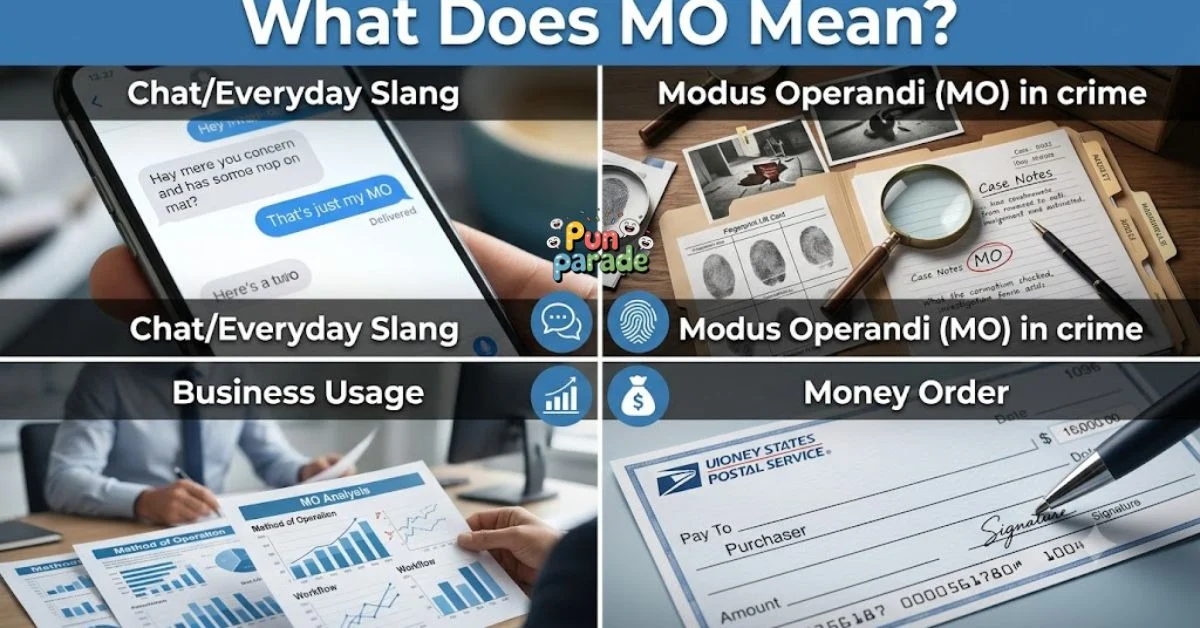
If you’ve come across “MO” in a text message, police report, TV crime show, or business document, you may have wondered what it actually means. The answer isn’t always straightforward because MO has several meanings, and the correct one depends on the situation.
For some people, MO simply refers to someone’s usual way of doing things. In criminal investigations, it has a much more specific meaning. Online, people may use it casually in chats, while in business or finance, it can stand for entirely different terms.
This guide explains every major meaning of MO, where it came from, how people use it today, and how to understand it confidently in real-life conversations.
MO Meaning – Quick Meaning
MO usually stands for “modus operandi,” a Latin phrase meaning “method of operating” or “usual way of doing something.”
In simple terms, it describes the way a person typically behaves or completes a task.
Quick facts
- Full form: Modus Operandi
- Language of origin: Latin
- Meaning: A person’s usual method or pattern
- Common uses: Crime, police work, business, conversations, relationships
Examples
“Showing up five minutes early is her MO.”
“The detective recognized the suspect’s MO.”
“Ignoring texts for hours is kind of his MO.”
Origin & Background
The phrase modus operandi originated in Latin, where modus means “method” and operandi means “of operating.”
Originally, lawyers and investigators used the phrase to describe recurring patterns of behavior. Over time, the expression spread into journalism, business, psychology, and everyday English.
Today, many people shorten it to simply MO, making it easier to use in casual conversation.
Television shows, especially crime dramas, have also made the term familiar to a wider audience. Series like Criminal Minds, detective movies, and true crime documentaries regularly mention a criminal’s MO when discussing investigations.
On social media, people have adopted the phrase in a lighter way. Instead of describing crimes, they use it to describe everyday habits.
Examples include:
- Sleeping late every weekend
- Ordering the same coffee every morning
- Forgetting birthdays
- Replying to messages hours later
The phrase has evolved from technical language into an everyday expression that describes predictable behavior.
Real-Life Conversations
Person A: You still haven’t replied to the group.
Person B: That’s my MO. I always catch up after work.
Instagram DM
Person A: Another sunset photo?
Person B: Yep, that’s basically my MO whenever I travel.
TikTok Comments
Person A: He disappeared after one date.
Person B: Sadly, that’s his MO according to everyone who knows him.
Text Messages
Person A: You’re always buying books instead of clothes.
Person B: Guilty. That’s been my MO for years.
Related Posts: What Does BMF Mean? The Real Meaning in Text, TikTok, Instagram & Relationships
Emotional & Psychological Meaning
When people say “that’s my MO,” they’re usually talking about a habit that has become part of their identity.
Sometimes the phrase is playful. Other times, it points to a personality trait that others immediately recognize.
Using MO often suggests consistency. It tells listeners that a behavior isn’t random—it happens regularly enough to become expected.
For example, imagine a friend who always checks in after a difficult day. After several years, everyone begins to expect that kindness.
You might hear someone say:
“Helping people through tough times has always been her MO.”
That simple sentence communicates reliability, trust, and character.
Psychologically, people enjoy recognizing patterns. Describing someone’s MO helps us understand and predict behavior, making conversations more meaningful.
Usage in Different Contexts
Social Media
On platforms like TikTok, Instagram, and X, MO usually describes someone’s signature habit.
Example:
“Posting gym selfies every morning is his MO.”
Friends & Relationships
Friends often use MO humorously to point out predictable behaviors.
Example:
“Canceling plans at the last minute is definitely your MO.”
It isn’t always criticism. Sometimes it’s affectionate teasing.
Work & Professional Settings
In professional environments, MO can describe someone’s preferred working style.
Examples:
- Solving problems through research
- Leading meetings calmly
- Responding to emails quickly
- Planning every detail before starting
Managers may say:
“Her MO is careful preparation before making decisions.”
Casual vs. Serious Tone
Casually, MO refers to habits.
Example:
“My MO is grabbing coffee before work.”
In serious discussions, especially investigations or legal matters, it refers to established behavioral patterns that may help identify a person.
The surrounding context usually makes the intended meaning clear.
When NOT to Use It
Although MO is common, there are situations where using it may confuse people.
Avoid using it when:
- Your audience may not know the abbreviation.
- You’re writing formal academic papers without defining it.
- You’re speaking with children who may misunderstand it.
- You’re discussing sensitive criminal cases casually.
- You’re communicating internationally where Latin abbreviations are less familiar.
In formal writing, spelling out modus operandi the first time is often the better choice.
Common Misunderstandings
Many people assume MO always relates to criminals because of television shows.
In reality, it describes any consistent pattern of behavior, whether positive, negative, or completely ordinary.
Another misunderstanding is thinking MO means personality.
It doesn’t.
Personality is broader, while an MO refers to specific recurring actions.
Some also confuse MO with motivation.
Your motivation explains why you do something.
Your MO explains how you usually do it.
Comparison Table
| Expression | Meaning | Common Context | Tone |
|---|---|---|---|
| MO (Modus Operandi) | Someone’s usual method or pattern | Everyday life, crime, work | Neutral |
| Habit | A repeated behavior | Daily routines | Neutral |
| Routine | A regular schedule or process | Personal and professional | Neutral |
| Style | A distinctive way of doing something | Creativity, work, personality | Positive |
| Approach | The method used to solve a problem | Business, education | Professional |
| Trademark Move | A signature action people recognize | Sports, entertainment, casual talk | Playful |
| Pattern | Repeated behavior over time | Psychology, investigations | Neutral |
| Out of Character (Opposite) | Behavior that is unusual for someone | Personal conversations | Negative or surprising |
Key Insight
While words like habit and routine describe repeated actions, MO emphasizes a person’s characteristic way of acting. It often reflects what others have come to expect, whether that’s a positive strength, an amusing quirk, or a behavior that stands out.
See Also: Third Wheeling Meaning: What It Really Means in Relationships, Friendships, and Modern Slang
Variations / Types of MO Meaning
1. MO Meaning in Crime
In criminal investigations, MO refers to the method a criminal repeatedly uses to commit offenses, helping investigators identify patterns between cases.
2. What Does MO Mean in Police Talk?
Police officers use MO to describe a suspect’s typical operating method, such as the time, location, or technique used during crimes.
3. What Does MO Mean in Chat?
In text messages and online conversations, MO usually means someone’s normal habit or typical behavior.
Example:
“Leaving everyone on read is his MO.”
4. MO Meaning in Relationships
In relationships, MO describes a partner’s consistent behavior or communication style.
Example:
“Planning surprise dates has always been her MO.”
5. What Does MO Mean in Business?
In business, MO refers to a company’s or individual’s preferred way of working, negotiating, or solving problems.
Example:
“Our MO is putting customers first.”
6. What Does MO Mean in Payment?
In finance, MO can also stand for Money Order, depending on the context.
For example:
“Please send payment by MO.”
Here, it has nothing to do with modus operandi.
7. MO Meaning in a Letter
In letters or official documents, MO may refer to a Money Order or occasionally Memorandum Order, depending on the organization and document type.
Always read the surrounding text to determine the intended meaning.
8. What Does M.O. Mean in Criminal Minds?
Fans of Criminal Minds often hear profilers discuss an unsub’s M.O. They use the term to describe the offender’s recurring methods, which help investigators connect crimes and predict future actions.
9. Personal MO
People also use MO to describe their own personality-driven habits.
Example:
“Staying organized has always been my MO.”
10. Professional MO
Teams may describe a coworker’s reliable working style as their MO.
Example:
“Her MO is checking every detail before approving a project.”
How to Respond When Someone Uses MO
Casual Replies
- “Sounds just like you.”
- “I figured that was your thing.”
- “That’s pretty typical!”
- “No surprise there.”
Funny Replies
- “You’ve got a very predictable MO!”
- “Breaking news—you stayed true to your MO again.”
- “Some habits never change.”
- “You’re nothing if not consistent.”
Mature Replies
- “Everyone has their own way of doing things.”
- “That approach seems to work well for you.”
- “I appreciate your consistency.”
- “It’s good to know what to expect.”
Respectful Replies
- “I understand that’s your usual approach.”
- “Thanks for explaining your perspective.”
- “Everyone has different working styles.”
- “That makes sense.”
Regional & Cultural Usage
Western Culture
In North America and much of Europe, MO is widely understood as shorthand for modus operandi. It’s common in news reports, crime shows, workplaces, and everyday conversations.
Asian Culture
In many Asian countries, people are more likely to recognize MO through English-language media or business communication. Outside those settings, the abbreviation may need explanation.
Middle Eastern Culture
English-speaking professionals and students may use MO in workplaces or universities, but everyday conversations often favor clearer, fully written expressions.
Global Internet Usage
Across social media, MO has become a casual way to describe recurring habits.
Examples include:
- “Ghosting people is his MO.”
- “Making memes is her MO.”
- “Being late is my MO.”
The meaning is usually lighthearted unless the discussion involves crime.
Gen Z vs. Millennials
Gen Z often uses MO jokingly in memes, TikTok captions, and group chats to describe relatable habits.
Millennials are more likely to use MO in professional discussions or after hearing it in crime dramas and news reports.
Despite these differences, both generations understand it as someone’s usual way of doing something.
Read More: YKTV Meaning: What It Really Means in Text, TikTok, Instagram, and Chat
Is It Safe for Kids?
Yes, MO is generally safe for kids when used to describe everyday habits or routines.
However, because the term is also common in crime investigations and detective shows, parents or teachers may need to explain its meaning when children encounter it in those contexts.
FAQs
What does MO mean in slang?
In everyday slang, MO means someone’s usual habit, behavior, or way of doing things. It’s often used humorously to describe predictable actions.
What does MO mean in chat?
In chats and text messages, MO usually stands for modus operandi, meaning a person’s typical pattern or style of behavior.
What does MO mean in a relationship?
In relationships, MO refers to a partner’s consistent way of communicating, expressing affection, or handling situations.
What does MO mean in police talk?
Police use MO to describe a suspect’s recurring method of committing crimes. Recognizing an MO can help connect related cases.
What does MO mean in business?
In business, MO describes an individual’s or company’s preferred method of working, making decisions, or serving customers.
What does MO mean in payment?
In financial documents, MO often stands for Money Order, which is a secure form of payment issued by a bank or postal service.
What does M.O. mean in Criminal Minds?
In Criminal Minds, M.O. refers to an offender’s modus operandi—the recurring methods they use to commit crimes, which profilers analyze to identify suspects.
What does MO stand for?
MO usually stands for Modus Operandi, a Latin phrase meaning someone’s usual method or way of doing something.
In some financial contexts, MO can also stand for Money Order.
What does a killer’s MO mean?
A killer’s MO refers to the recurring methods or techniques they use when committing crimes. Investigators study an MO to identify patterns and connect related cases.
What does your MO mean in slang?
In slang, your MO means your typical habit, behavior, or way of doing things. For example, “Staying up late is your MO” means it’s something you usually do.
What is a MO short for?
MO is most commonly short for Modus Operandi, meaning a person’s usual method of operating. Depending on the context, it may also be short for Money Order or another organization-specific term.
Conclusion
The meaning of MO depends entirely on the context, but its most common definition is modus operandi, or a person’s usual way of doing things. Whether you’re chatting with friends, reading a business email, watching a crime drama, or browsing social media, understanding the context makes it easy to interpret.
Today, MO is no longer limited to police investigations. People use it to describe everyday habits, relationship patterns, work styles, and even online personalities. From saying, “That’s just my MO,” to hearing detectives discuss a suspect’s methods, the phrase has become part of modern English.
The next time you see MO, look at the surrounding conversation. A quick glance at the context will tell you whether it refers to a personal habit, a professional approach, a criminal investigation, or even a Money Order. Knowing these different meanings will help you communicate more confidently and avoid common misunderstandings.
