
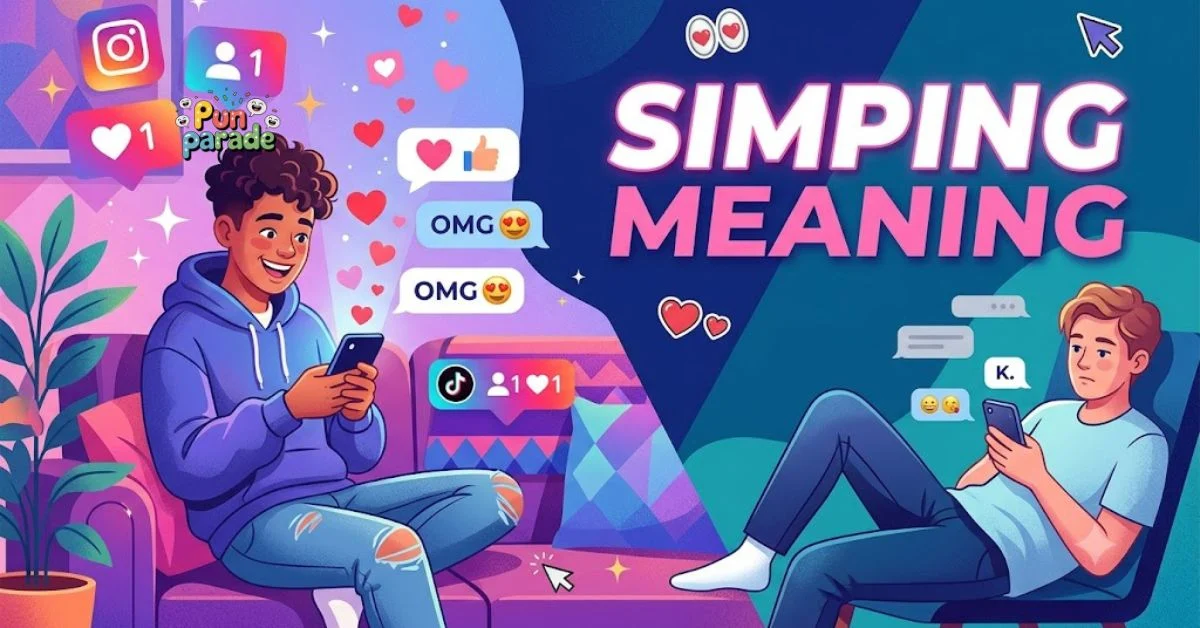
If you spend time on TikTok, Instagram, gaming communities, or group chats, you’ve probably seen someone comment, “Bro is simping hard.” The phrase appears everywhere online, yet many people are still unsure what it actually means.
Some think simping means being deeply in love. Others use it to describe someone who gives too much attention to another person. Because the term is often used jokingly, its meaning can become confusing.
This guide explains the simping meaning, where the word came from, how people use it in real conversations, and when using it can lead to misunderstandings. By the end, you’ll understand the term confidently and know how it fits into modern communication and relationships.
Simping Meaning – Quick Meaning
Simping is a slang term that describes someone who shows excessive admiration, attention, or affection toward another person, often without receiving the same level of interest in return.
Simple Definition
Simping usually involves:
- Trying too hard to impress someone
- Giving constant compliments or attention
- Prioritizing another person’s needs above your own
- Seeking approval from someone you like
Quick Examples
“He bought her coffee every day and she barely noticed him. His friends said he was simping.”
“She’s always defending that celebrity online. People call it simping.”
“I like her, but I’m not simping. I just enjoy talking to her.”
Simping Meaning in English
In English, simping refers to showing extreme devotion or admiration toward someone, especially in a romantic context.
The word usually carries a playful or teasing tone. However, it can sometimes be used critically to suggest that someone is sacrificing self-respect or trying too hard for another person’s attention.
Related Posts: What Does ICL Mean in Text? Full Meaning, Usage, and Real-Life Examples Explained
Origin and Background
The word simp existed long before social media. Decades ago, it was used informally to describe someone who appeared foolish because they were overly focused on pleasing another person.
Over time, internet culture transformed its meaning.
Around the late 2010s, platforms like TikTok, Twitch, and Twitter made the term extremely popular. Content creators and online communities started calling someone a “simp” whenever they showed strong admiration toward a crush, influencer, or celebrity.
Eventually, the term evolved.
Today, simping can mean:
- Genuinely liking someone
- Giving excessive attention
- Playfully supporting a favorite celebrity
- Acting overly devoted in a relationship
The meaning often depends entirely on context and tone.
Real-Life Conversations
WhatsApp Chat
Person A: I stayed awake until 2 a.m. helping her with her assignment.
Person B: You barely know her. That’s some serious simping.
Instagram DMs
Person A: I liked all her photos from 2024.
Person B: You’re definitely simping right now.
TikTok Comments
Commenter 1: I’d travel across the world just to meet him.
Commenter 2: The simping is unreal.
Text Message
Person A: I bought him his favorite snacks again.
Person B: That’s sweet, but don’t become a full-time simp.
These conversations show that simping is often used humorously rather than as a harsh insult.
Emotional and Psychological Meaning
Simping usually reflects a desire for connection, appreciation, or romantic attention.
People naturally want to impress someone they admire. They may:
- Give compliments
- Offer help
- Spend extra time with someone
- Seek emotional closeness
Psychologically, simping can reveal:
Admiration
People often go out of their way for someone they genuinely like.
Hope
Many acts of simping come from the belief that affection may eventually be returned.
Need for Validation
Sometimes people seek approval from someone they admire because it makes them feel valued.
Emotional Investment
Strong feelings can lead someone to prioritize another person’s happiness above their own.
A Real-Life Scenario
Imagine a university student who constantly offers notes, sends encouraging messages, and rearranges his schedule for someone he likes. His friends jokingly call him a simp. In reality, he simply wants to make a good impression and hopes the relationship develops naturally.
This example shows that simping is not always negative. It often reflects normal human emotions that become excessive when boundaries disappear.
See Also: Situationship Meaning: The Modern Relationship That Feels Real but Isn’t Fully Defined
Usage in Different Contexts
Social Media
Social media is where the term appears most often.
Examples:
- Defending a celebrity online
- Leaving countless compliments
- Constantly interacting with someone’s content
Example:
“She’s simping for that actor in every comment section.”
Friends and Relationships
Friends commonly use the word jokingly.
Example:
“You’re driving an hour just to bring him coffee? That’s simping.”
In relationships, the term can describe someone who gives significantly more effort than their partner.
Work and Professional Settings
Simping is generally inappropriate in professional environments.
Calling a colleague a simp can sound disrespectful and may create misunderstandings.
Professional communication should avoid slang that questions someone’s motives or behavior.
Casual vs. Serious Tone
Casual:
“I’m simping for this singer’s new album.”
Serious:
“He’s sacrificing his own happiness trying to please someone who doesn’t appreciate him.”
The same word can be playful or critical depending on how it is used.
When NOT to Use It
Avoid using the term in these situations:
Professional Settings
The slang may seem immature or disrespectful.
Sensitive Relationships
Calling someone’s genuine feelings “simping” can hurt them.
Cultural Differences
Not everyone understands internet slang.
Serious Emotional Situations
Someone supporting their partner through a difficult period should not automatically be labeled a simp.
The term works best in lighthearted conversations among people who understand its intended meaning.
Common Misunderstandings
Misunderstanding 1: Simping Means Love
Not necessarily.
Love involves mutual care and respect. Simping usually suggests excessive admiration.
Misunderstanding 2: Every Nice Person Is Simping
Being kind does not automatically make someone a simp.
Misunderstanding 3: Simping Is Always Bad
Many people use the term jokingly and positively.
Misunderstanding 4: Only Men Simp
Anyone can simp regardless of gender.
Misunderstanding 5: Simping Means Weakness
The term often exaggerates normal affection and emotional investment.
Read More: HG Full Form in Chat Meaning: What It Really Means in Text, Instagram & Social Media
Comparison Table
| Expression | Meaning | Tone |
|---|---|---|
| Simping | Excessive admiration or attention | Playful or critical |
| Crushing | Having romantic feelings | Neutral |
| Flirting | Showing romantic interest | Positive |
| Fanboying/Fangirling | Enthusiastic admiration | Positive |
| Obsessed | Extremely fixated | Usually negative |
| Ignoring | Showing little interest | Opposite behavior |
| Being Independent | Maintaining emotional boundaries | Opposite behavior |
Key Insight:
Simping sits somewhere between normal admiration and unhealthy over-investment. The context determines whether the word sounds funny, affectionate, or critical.
Variations and Types of Simping
1. Celebrity Simping
Excessively admiring actors, singers, or influencers.
2. Relationship Simping
Constantly prioritizing a romantic interest.
3. Gaming Simping
Giving special treatment to someone in online games.
4. Social Media Simping
Commenting, liking, and interacting excessively online.
5. Friendship Simping
Trying too hard to gain a friend’s approval.
6. Fictional Character Simping
Being deeply attached to characters from books or movies.
7. Academic Simping
Doing favors to impress a classmate.
8. Workplace Simping
Trying excessively to gain approval from someone at work.
9. Reverse Simping
Pretending not to care while secretly being very invested.
10. Meme Simping
Using the term jokingly for humorous internet content.
Simping Meaning in Chat
In chats and text messages, simping generally means showing a lot of interest, attention, or affection toward someone.
Examples:
- “You’re texting her every five minutes. Stop simping.”
- “I admit it. I’m simping for him.”
In chats, the word is usually playful rather than serious.
What Is Simping for a Girl?
For a girl, simping has the same meaning as it does for anyone else.
A girl may be called a simp if she:
- Constantly seeks someone’s attention
- Gives excessive compliments
- Prioritizes another person’s needs above her own
- Appears overly invested in someone who gives little in return
The term is gender-neutral and applies to everyone.
Simping Meaning in Relationship
In relationships, simping often describes one-sided effort.
Examples include:
- Always making sacrifices without appreciation
- Constantly seeking validation
- Ignoring personal boundaries to please a partner
Healthy relationships involve mutual respect and balanced effort. Excessive self-sacrifice may be described as simping.
Simping Meaning Synonyms
Common synonyms include:
- Overly devoted
- Infatuated
- Lovestruck
- Admirer
- Obsessed
- Enamored
- Doting
- Over-attached
- Fanatical
- Smitten
Each carries slightly different emotional meanings.
Simping Meaning in Arabic
The exact slang equivalent varies, but simping is often explained in Arabic as:
المبالغة في إظهار الإعجاب أو الاهتمام بشخص ما
Translation:
“Exaggerating admiration or attention toward someone.”
The concept exists in many cultures even if the exact slang term differs.
Simping in a Sentence
Here are examples:
- “My friends say I’m simping because I always reply to her messages immediately.”
- “He’s simping over his favorite singer again.”
- “I like him, but I’m not simping.”
- “The internet called him a simp after he bought expensive gifts for his crush.”
How to Respond When Someone Uses It
Casual Replies
- “Maybe a little.”
- “I can’t deny it.”
Funny Replies
- “I’m not simping. I’m conducting research.”
- “I prefer the term dedicated admirer.”
Mature Replies
- “I simply appreciate this person.”
- “There’s nothing wrong with caring about someone.”
Respectful Replies
- “Everyone expresses affection differently.”
- “I’m just being supportive.”
Regional and Cultural Usage
Western Culture
The term is widely used online and often carries humor and teasing.
Asian Culture
Internet communities commonly use the term, especially among younger generations and fandoms.
Middle Eastern Culture
People understand the idea of excessive admiration, although the English slang itself may be less common.
Global Internet Usage
Memes and social media have made simping a worldwide expression.
Gen Z vs Millennials
Gen Z: Uses the term frequently and often jokingly.
Millennials: Usually understand the slang but may use it less often and more selectively.
Is It Safe for Kids?
Generally, yes.
Simping is internet slang and is not inherently offensive. However, parents and educators should explain that healthy relationships involve mutual respect and personal boundaries.
Children should understand that kindness and admiration are positive qualities, but excessive people-pleasing can sometimes become unhealthy.
FAQs
What exactly does simping mean?
It means showing excessive admiration or attention toward someone, often in a romantic context.
Is simping always negative?
No. It can be playful, affectionate, or mildly critical depending on the situation.
Can girls be called simps?
Yes. The term applies equally to all genders.
Is simping the same as being in love?
No. Love is mutual care, while simping usually suggests excessive or one-sided attention.
Why do people use the word simp online?
It is a quick, humorous way to describe intense admiration or devotion.
Is simping considered flirting?
Not necessarily. Flirting is intentional romantic communication, while simping often implies going beyond normal admiration.
Can simping hurt relationships?
It can if one person constantly gives while receiving little appreciation in return.
What does simping someone mean?
Simping someone means giving them excessive attention, admiration, or affection, often while expecting little or nothing in return. It usually refers to trying very hard to impress or please someone you like.
Is simping flirting?
Not always. Flirting is playful romantic interest, while simping usually implies going beyond normal admiration or trying too hard. A person can flirt without simping and simp without flirting.
Is simping romantic?
Often, yes. Simping commonly happens when someone has a crush or romantic feelings for another person.
However, people can also simp for celebrities, influencers, or fictional characters.
What is slang for simping?
Common slang terms similar to simping include crushing, fangirling, fanboying, thirsting, and being down bad.
These expressions all describe strong admiration or attraction, though each has a slightly different meaning.
Conclusion
The simping meaning has evolved from an old slang term into one of the internet’s most recognizable expressions. Today, it usually refers to showing excessive admiration, attention, or devotion toward someone, often in a playful and humorous way.
The word is flexible and highly dependent on context. Sometimes it describes harmless admiration for a celebrity or crush. Other times, it highlights one-sided effort and a lack of personal boundaries.
Understanding the term helps you navigate modern conversations more confidently. Like many internet expressions, simping is best understood through context, tone, and the relationships involved.
