
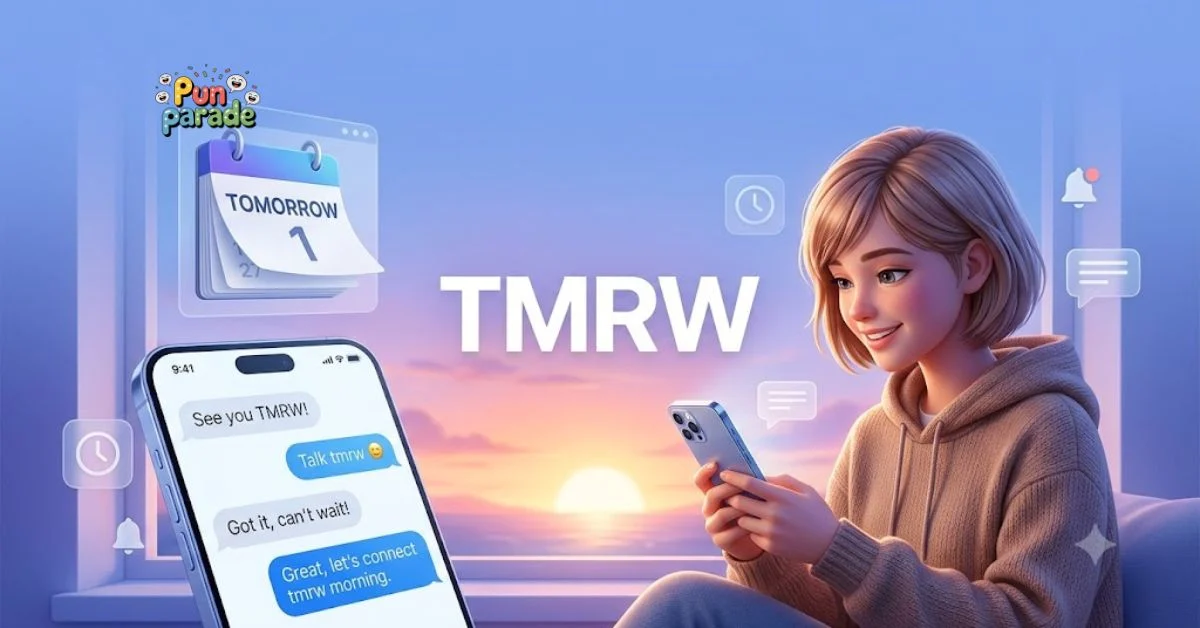
If you’ve ever received a message saying “See you TMRW” or spotted #TMRW in a social media caption, you may have wondered what it actually means. While it looks simple, this short form has become a common part of modern digital communication, especially among younger users who prefer quick and effortless texting.
People search for TMRW meaning because it appears in text messages, WhatsApp chats, Instagram captions, TikTok comments, and even brand names. Some also confuse it with similar abbreviations like TMW, tmr, or TMRW Sports, making its meaning less obvious.
The good news is that it’s one of the easiest internet abbreviations to understand. Once you know how and when people use it, you’ll recognize it almost everywhere online.
TMRW Meaning – Quick Meaning
TMRW is a shortened form of “tomorrow.” It’s commonly used in texting and online conversations to save time while keeping messages casual and friendly.
Quick Definition
- Full form: Tomorrow
- Tone: Casual and informal
- Common platforms: WhatsApp, Instagram, TikTok, Snapchat, Discord, X, and text messages
- Purpose: To type faster without changing the meaning
Examples
“I’ll send the photos tmrw.”
“Let’s finish this TMRW.”
“Talk to you tmrw, have a good night!”
In every example, TMRW simply replaces the word tomorrow.
Origin & Background
Like many texting abbreviations, TMRW became popular because people wanted quicker ways to communicate on mobile phones.
Years ago, SMS messages had strict character limits, and phone keyboards were much slower than today’s smartphones. Users naturally shortened common words such as:
- Tomorrow → TMRW
- Please → Pls
- Thanks → Thx
- Before → B4
Even though texting technology has improved, these abbreviations remained popular because they’re fast, familiar, and widely understood.
Social media helped spread TMRW even further. Twitter’s early character limits encouraged shorter writing, while apps like Snapchat and Instagram made quick conversations the norm.
Today, TMRW isn’t just internet slang—it’s part of everyday digital language.
Many companies have also adopted the spelling TMRW because it sounds modern, forward-thinking, and memorable.
Read More: Please Disregard My Previous Email: Meaning, Examples, Professional Usage & Best Alternatives
Real-Life Conversations
Person A: Are we still meeting?
Person B: Yes! Let’s meet tmrw around 4.
Instagram DM
Person A: Did you watch the new episode?
Person B: Not yet. I’ll watch it tmrw so don’t spoil anything.
TikTok Comments
Person A: New vlog dropping?
Creator: Yep! See you all tmrw.
Text Message
Person A: Can you help me with my presentation?
Person B: Of course. I’ll call you tmrw after work.
These examples show that TMRW simply replaces the full word without changing the message’s meaning.
Emotional & Psychological Meaning
Although TMRW literally means “tomorrow,” it often carries emotional meaning depending on the conversation.
Sometimes it expresses:
- Hope
- Anticipation
- Optimism
- Patience
- Reassurance
For example, when someone says:
“We’ll figure it out tmrw.”
They’re not only talking about time. They’re also suggesting that today’s stress can wait and tomorrow offers another chance.
Likewise, a friend texting:
“Good luck. Talk tmrw ❤️”
adds warmth and comfort, even with such a short message.
A Real-Life Scenario
Imagine you’ve had a difficult day at work. A close friend texts:
“Get some rest. We’ll deal with everything tmrw.”
That single abbreviation can make the conversation feel calmer. It shifts attention away from today’s problems and toward tomorrow’s possibilities. Even a simple shortcut can carry reassurance when used with the right tone.
Usage in Different Contexts
The meaning of TMRW stays the same across most conversations, but the tone changes depending on where it’s used and who you’re talking to.
Social Media
On platforms like Instagram, TikTok, Snapchat, and X, TMRW is a quick way to announce future plans or build excitement.
Examples:
- “New video drops tmrw!”
- “Big surprise coming tmrw.”
- “Can’t wait for tmrw.”
Creators and brands often use it because it’s short, eye-catching, and fits naturally into captions.
Friends & Relationships
Among friends, TMRW sounds relaxed and friendly.
Examples:
- “Let’s grab coffee tmrw.”
- “I’ll call you tmrw.”
- “See you tmrw!”
In relationships, it can also express reassurance or excitement.
Example:
- “Sleep well. I’ll see you tmrw ❤️”
Work & Professional Settings
Although people understand TMRW, it’s usually better to write tomorrow in professional emails, reports, or formal business communication.
Instead of:
I’ll finish it tmrw.
Write:
I’ll finish it tomorrow.
In workplace chats like Slack or Microsoft Teams, using tmrw with close colleagues is generally acceptable if your team’s communication style is informal.
Casual vs. Serious Tone
| Context | Appropriate? | Why |
|---|---|---|
| Text messages | ✅ Yes | Natural and friendly |
| ✅ Yes | Very common | |
| ✅ Yes | Frequently used | |
| TikTok | ✅ Yes | Popular abbreviation |
| Snapchat | ✅ Yes | Fits casual conversations |
| ❌ Usually no | Write “tomorrow” instead | |
| Job application | ❌ No | Too informal |
| Academic paper | ❌ No | Use standard English |
See Also: Big Back Meaning: What It Really Means in Gen Z Slang, TikTok & Memes
When NOT to Use It
Even though TMRW is widely understood, there are situations where spelling out tomorrow is the better choice.
Formal Communication
Avoid using it in:
- Business emails
- Cover letters
- College assignments
- Legal documents
- Official announcements
Professional writing values clarity over speed.
When Speaking With Someone Unfamiliar With Internet Slang
Older relatives, clients, or international contacts may not recognize TMRW immediately.
Using the full word prevents unnecessary confusion.
Serious Situations
Messages involving health, emergencies, contracts, or important deadlines deserve clear language.
For example, instead of:
Surgery is tmrw.
Write:
Surgery is tomorrow.
The complete word feels more appropriate and respectful.
Common Misunderstandings
Although TMRW seems straightforward, people still misunderstand it in several ways.
Thinking It’s a New Slang Word
Some assume TMRW has a hidden meaning or represents an emotion.
It doesn’t.
It simply means tomorrow.
Confusing It With TMW
TMW often means “That Moment When.”
Example:
TMW you finally finish your exams.
Meanwhile:
TMRW = Tomorrow.
The two abbreviations are unrelated.
Assuming It’s Only for Gen Z
While younger users helped popularize it, Millennials, professionals, brands, and even news outlets occasionally use TMRW in informal content.
Believing It’s Incorrect English
It’s perfectly acceptable in casual digital communication.
It’s simply not suitable for formal writing.
Comparison Table
| Expression | Meaning | Typical Tone |
|---|---|---|
| TMRW | Tomorrow | Casual |
| tmr | Tomorrow | Very casual |
| Tomorrow | Full word | Neutral |
| TMW | That Moment When | Humorous |
| Soon | In the near future | Flexible |
| Later | At a later time | Informal |
| ASAP | As soon as possible | Urgent |
| Eventually | At some future point | Less specific |
Key Insight
Although several expressions refer to future time, TMRW is unique because it points to one specific day while keeping conversations quick and relaxed. It’s ideal for everyday texting but should be replaced with tomorrow whenever professionalism or clarity matters.
Variations and Related Terms
Here are some common variations you’ll see online.
1. TMR
Another shortened version of tomorrow, often used in fast texting.
2. TMW
Usually means That Moment When, not tomorrow.
3. Tomorrow
The complete standard English spelling used in formal writing.
4. Tomo
A casual nickname for tomorrow used in some online communities.
5. 2moro
An older texting abbreviation that replaces “to” with the number 2.
6. 2mrw
A more compact version combining numbers and letters.
7. Cya TMRW
Means “See you tomorrow.”
8. CU TMRW
A shortened version of “See you tomorrow.”
9. TMRW Morning
Specifically refers to tomorrow morning.
10. TMRW Night
Used when referring to tomorrow evening or nighttime plans.
How to Respond When Someone Uses TMRW
Casual Replies
- Sounds good!
- See you then.
- Can’t wait.
- Talk tomorrow!
Funny Replies
- If tomorrow ever arrives!
- Only if coffee comes first.
- Deal—but don’t oversleep.
- Tomorrow is future me’s problem.
Mature Replies
- Looking forward to it.
- Thanks for letting me know.
- I’ll be ready tomorrow.
- Have a great evening until then.
Respectful Replies
- Certainly. I’ll see you tomorrow.
- Thank you. Speak with you tomorrow.
- I appreciate the update.
- Have a safe and restful night.
Regional & Cultural Usage
Although TMRW always means “tomorrow,” how often it’s used varies across cultures, age groups, and communication styles.
Western Culture
In countries like the United States, Canada, the United Kingdom, and Australia, TMRW is a familiar texting abbreviation. You’ll often see it in personal messages, social media captions, event promotions, and online communities.
Examples include:
- “See you tmrw!”
- “New collection drops tmrw.”
- “We’ll finish it tmrw.”
Because casual digital communication is common, most people immediately recognize the abbreviation.
Asian Culture
Across many Asian countries, English abbreviations such as TMRW, LOL, BRB, and IMO appear frequently among students and young professionals.
However, in more formal environments, people usually prefer writing the complete word tomorrow, especially in emails, school assignments, and workplace communication.
Middle Eastern Culture
English is widely used online throughout many Middle Eastern countries, particularly on social media. Younger users often mix English abbreviations with Arabic or other local languages.
For example:
- “Insha’Allah, see you tmrw.”
The abbreviation remains the same, even when combined with expressions from different languages.
Global Internet Usage
Today, TMRW is understood almost everywhere people communicate in English online. You’ll find it in:
- WhatsApp chats
- Instagram captions
- TikTok comments
- Discord servers
- Snapchat messages
- Online gaming
- YouTube comments
- Group chats
Its popularity comes from being short, clear, and easy to type.
Gen Z vs. Millennials
Both generations use TMRW, but their writing styles can be slightly different.
Gen Z
- Uses more abbreviations and internet slang.
- Often combines TMRW with emojis, memes, or trending phrases.
- Prefers quick, conversational messages.
Example:
“See u tmrw 😂”
Millennials
- Also use TMRW, but often write full sentences.
- May choose the complete word tomorrow in professional or mixed-age conversations.
Example:
“Looking forward to seeing you tomorrow.”
The difference is usually about communication style rather than meaning.
Read More: Goated Meaning: What It Really Means in Slang, TikTok & Everyday Conversations
Is It Safe for Kids?
Yes. TMRW is generally considered a safe and harmless abbreviation because it simply means “tomorrow.”
Unlike some internet slang that may have hidden or mature meanings, TMRW doesn’t contain offensive language or inappropriate content. It’s commonly used by students, families, teachers, and friends in everyday conversations.
Parents should still encourage children to understand when casual abbreviations are appropriate and when standard spelling is a better choice, such as in homework, formal emails, or school projects.
Frequently Asked Questions
What does TMRW mean in chat?
TMRW is a shortened form of “tomorrow.” People use it in chats and text messages to type faster while keeping the meaning clear.
What is the difference between TMRW and TMR?
Both refer to tomorrow, but TMRW is the more common and widely recognized abbreviation.
Is TMRW a Gen Z slang word?
Not exactly. It’s a texting abbreviation rather than slang. Gen Z uses it often, but people of all ages use it in casual online conversations.
Can I use TMRW in WhatsApp?
Yes. TMRW is widely used in WhatsApp chats, group conversations, and personal messages because it’s quick and easy to understand.
Is TMRW appropriate for work?
It’s acceptable in informal workplace chats if your team communicates casually. For emails, reports, and official documents, write tomorrow instead.
What does TMW mean?
TMW usually stands for “That Moment When,” which is different from TMRW, meaning “tomorrow.”
Why do people shorten tomorrow to TMRW?
People shorten common words to save time while texting. TMRW is faster to type and has become a familiar abbreviation across social media and messaging apps.
What does TMRW mean in texting?
TMRW is a common texting abbreviation for “tomorrow.” It helps people type faster in chats, texts, and social media conversations.
What is the full form of TMRW?
The full form of TMRW is “Tomorrow.” It’s simply a shortened spelling used in informal digital communication.
Is it TMW or TMRW?
TMRW means “tomorrow,” while TMW usually stands for “That Moment When.” They have different meanings and aren’t interchangeable.
What is slang for tomorrow?
Common slang or short forms for tomorrow include TMRW, TMR, 2moro, and 2mrw. These are mostly used in texting and social media.
Conclusion
TMRW may be only four letters long, but it’s one of the most recognizable abbreviations in modern digital communication. Whether you’re sending a WhatsApp message, replying to an Instagram DM, or commenting on TikTok, it offers a quick and friendly way to say “tomorrow.”
The key is knowing your audience. In casual conversations, TMRW feels natural, efficient, and conversational. In professional, academic, or formal settings, writing the full word tomorrow shows greater clarity and professionalism.
As online language continues to evolve, abbreviations like TMRW remind us that effective communication isn’t always about using more words—it’s about choosing the right ones for the moment.
