
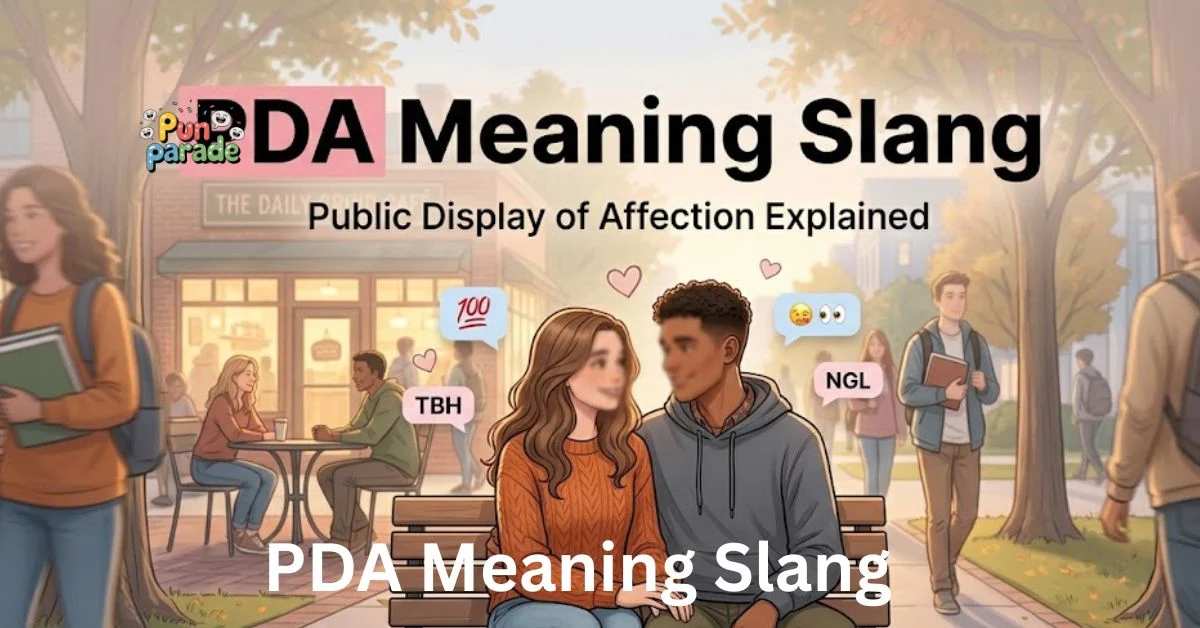
If you’ve ever been scrolling through social media or chatting with friends and suddenly seen someone mention “PDA,” you’re not alone in feeling confused. This small abbreviation carries a surprisingly big meaning in everyday conversations.
Most people search for PDA meaning slang because they’re unsure whether it refers to technology, psychology, or relationships. The truth is, context changes everything.
In modern slang, PDA is mostly about how people express affection in public. But it can also show up in school discussions, online comments, or even medical or psychological contexts.
Understanding it properly helps avoid misunderstandings—especially in relationships where tone matters more than words.
PDA Meaning Slang – Quick Meaning
In slang, PDA stands for Public Display of Affection.
It refers to physical or emotional expressions of love or closeness shown in public spaces.
Common examples include:
- Holding hands in public
- Hugging or kissing in front of others
- Sitting very close in public places
Simple interpretation:
- “They’re very open with their affection in public.”
- “I’m not comfortable with PDA.”
- “Too much PDA at school today!”
👉 In short, PDA = showing affection openly where others can see it.
Origin & Background
The term PDA originally comes from formal English, not slang. It was widely used in psychology, education, and social behavior studies long before it became internet slang.
Over time, social media platforms like Instagram, TikTok, and Twitter turned it into a casual expression. Instead of sounding academic, it became part of everyday relationship talk.
Cultural influence also played a big role. In Western countries, PDA is often seen as normal or even romantic. In contrast, many Asian and Middle Eastern cultures consider it more private or inappropriate in public spaces.
As global communication grew online, the term became universally recognized—but with different emotional interpretations depending on culture.
Today, “PDA” is not just a term; it reflects how society views love, boundaries, and public behavior.
Real-Life Conversations (MANDATORY)
📱 WhatsApp Chat
Person A: Are they dating or what?
Person B: Yeah, but they do too much PDA in class 😭
Person A: Like kissing in front of everyone?
Person B: Exactly, teachers are annoyed now.
📸 Instagram DM
Person A: Your pics with him are cute!
Person B: Thanks! We try to keep PDA low though 😂
Person A: Smart, people online always judge too much.
🎵 TikTok Comment Section
Person A: This couple is adorable
Person B: True but the PDA is getting a bit much ngl
Person C: Let them live their life lol
💬 Text Message
Person A: My parents saw us holding hands 😬
Person B: Oops… that’s some serious PDA exposure
Person A: I’m never sitting next to you in public again 😭
Related Posts: What Does ICL Mean? The Real Meaning, Origins, and How People Use It Today
Emotional & Psychological Meaning
PDA is not just about physical actions—it reflects emotional comfort, attachment style, and social awareness.
People who engage in PDA often:
- Feel emotionally secure in their relationship
- Express affection openly without fear of judgment
- Value physical closeness as reassurance
On the other hand, people who avoid PDA might:
- Prefer privacy in emotional expression
- Feel culturally or personally uncomfortable
- Separate public behavior from private emotions
Short real-life scenario:
A couple sitting in a park holds hands quietly. One partner feels happy and secure, while the other keeps looking around, worried about being seen. This small moment shows how PDA is not just behavior—it’s also about comfort levels and upbringing.
In modern communication, PDA also reflects emotional identity. People use it to signal confidence, love, or sometimes even rebellion against social expectations.
Usage in Different Contexts
Social Media
Used in captions or comments:
- “Too much PDA, but cute 😂”
- “We don’t do PDA, we do privacy.”
Friends & Relationships
Common in casual talk:
- “They’re always doing PDA in public.”
- “I’m okay with light PDA, not too much.”
Work / Professional Settings
Rare but may appear in discussions:
- “Let’s avoid PDA in office environments.”
Casual vs Serious Tone
- Casual: humorous, teasing
- Serious: boundaries, discomfort, cultural expectations
When NOT to Use It
PDA should be avoided or used carefully in:
- Formal conversations (job interviews, official settings)
- Sensitive cultural environments
- Situations involving strict school rules
- Discussions where privacy is important
Using it incorrectly can sound judgmental, especially when referring to couples in a negative tone.
Common Misunderstandings
Many people misunderstand PDA as:
- Only kissing (it also includes hugging, holding hands, etc.)
- Always inappropriate (depends on culture and context)
- A negative term (it can be neutral or positive)
Tone confusion is common online. Saying “too much PDA” can sound judgmental even if meant jokingly.
Another confusion is mixing PDA with technology (like “Personal Digital Assistant”), but in slang conversations, it almost always refers to affection.
Read More: IYKYK Meaning: What It Really Means, Where It Came From, and How to Use It Correctly
Comparison Table
| Term | Meaning | Tone | Context |
|---|---|---|---|
| PDA | Public display of affection | Neutral/romantic | Social, relationships |
| Private affection | Emotional intimacy in private | Positive | Personal relationships |
| No PDA | Avoiding public affection | Neutral/boundary-based | Cultural, school, workplace |
| Oversharing | Excessive public personal details | Negative | Social media |
| Flirting | Playful romantic behavior | Neutral | Dating context |
Key Insight:
PDA is not about right or wrong behavior—it’s about comfort levels, culture, and emotional boundaries.
Variations / Types of PDA
- Light PDA – Holding hands or brief hugs
- Moderate PDA – Sitting close, arm around shoulder
- Heavy PDA – Kissing in public spaces
- Emotional PDA – Sweet words or affectionate gestures publicly
- Online PDA – Romantic posts or captions on social media
- Teen PDA – School or college-age public affection
- Casual PDA – Unplanned small gestures of affection
- Romantic PDA – Intentional expressions of love in public
- Cultural PDA – Varies depending on societal norms
- Restricted PDA – Controlled due to rules or environment
How to Respond When Someone Uses It
Casual Replies
- “Yeah, they’re kinda cute with it 😂”
- “Not my thing, but okay”
Funny Replies
- “They’re basically in a romance movie at this point”
- “Someone give them a privacy filter 😭”
Mature Replies
- “Everyone has different comfort levels with PDA”
- “It depends on what they’re okay with”
Respectful Replies
- “As long as they’re comfortable, it’s fine”
- “Different cultures see it differently”
Regional & Cultural Usage
Western Culture
PDA is generally accepted and common among couples.
Asian Culture
Often more reserved; PDA may be considered inappropriate in many public settings.
Middle Eastern Culture
Typically more conservative; public affection is usually discouraged.
Global Internet Usage
Online, PDA is often joked about, criticized, or celebrated depending on audience.
Generational Differences
- Gen Z: More open, casual, meme-driven usage
- Millennials: Balanced, context-aware approach
- Older generations: More conservative interpretation
See Also: 1437 Meaning: The Hidden Love Code Behind “I Love You Forever”
Is It Safe for Kids?
Yes, the term itself is safe. However, children may interpret it differently depending on exposure.
In school environments, PDA is often discussed as part of behavior rules rather than romantic context.
Parents and educators usually use it to teach boundaries and appropriate public behavior.
FAQs
1. What does PDA mean in slang?
It means Public Display of Affection, referring to showing love in public.
2. Is PDA always kissing?
No, it includes holding hands, hugging, and other affectionate gestures.
3. What does no PDA mean in a relationship?
It means a couple prefers not to show affection publicly.
4. What does PDA mean in school?
It refers to students showing affection, which may be restricted by school rules.
5. Is PDA good or bad?
It depends on culture, context, and personal comfort levels.
6. What is PDA meaning autism?
It can also refer to Pathological Demand Avoidance in psychology, unrelated to slang.
Why do people avoid PDA?
Due to cultural norms, privacy preferences, or personal comfort.
What does PDA mean in a relationship?
PDA means Public Display of Affection, showing love openly in public. It includes holding hands, hugging, or kissing in front of others.
What is PDA in Gen Z slang?
In Gen Z slang, PDA means openly expressing affection in public spaces. It’s often used casually to describe couples being touchy in public.
What is considered an inappropriate PDA?
Inappropriate PDA is excessive or intimate behavior in public places. It includes intense kissing or touching that makes others uncomfortable.
What is PDA in a relationship?
In relationships, PDA means showing love or affection in public settings. It reflects how openly a couple expresses their emotional connection.
Conclusion
PDA is more than just a slang abbreviation—it’s a reflection of how people express love in public spaces. While some see it as romantic and natural, others view it as something private and personal.
Understanding PDA meaning slang helps you interpret conversations correctly, especially in relationships, social media, and cultural discussions.
At the end of the day, PDA is not about rules—it’s about respect, comfort, and emotional awareness between people.
When used thoughtfully, it becomes less about judgment and more about understanding how love is expressed differently around the world.
