
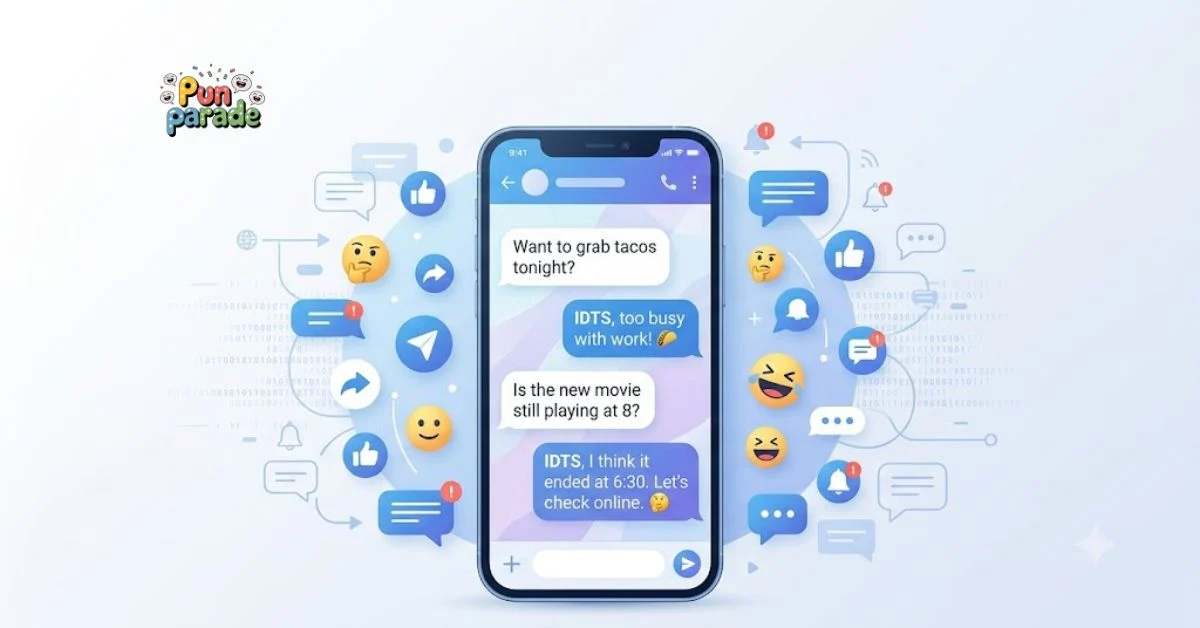
If you’ve come across IDTS in a text message, TikTok comment, Snapchat chat, or Instagram DM, you’re probably wondering what it actually means. Like many internet abbreviations, its meaning isn’t always obvious, especially if you’re seeing it for the first time.
The confusion comes from the fact that IDTS can have different meanings depending on the conversation. In most casual online chats, it simply expresses doubt or disagreement, but in other fields like medicine or business, the same letters may represent something entirely different.
This guide explains the meaning of IDTS in text, where it came from, how people use it today, when to avoid it, and how it compares with similar internet slang. By the end, you’ll know exactly how to understand—and confidently use—IDTS in everyday conversations.
IDTS Meaning in Text – Quick Meaning
In texting and online messaging, IDTS usually stands for:
“I Don’t Think So.”
People use it when they politely disagree, express uncertainty, or gently reject an idea.
Quick facts
- Full form: I Don’t Think So
- Tone: Casual, conversational
- Common platforms: Text messages, Snapchat, Instagram, TikTok, Discord, X (Twitter), WhatsApp
- Purpose: Express doubt, disagreement, or skepticism
Examples
“Are they coming tonight?”
“IDTS.”
“Do you think we’ll finish today?”
“IDTS, there’s still a lot left.”
“Is the store still open?”
“IDTS.”
Although it sounds negative, IDTS is often softer than simply saying “No.”
Origin & Background
Internet abbreviations became popular during the early days of SMS texting when character limits encouraged shorter messages.
Expressions like:
- LOL
- BRB
- IMO
- TBH
- IDK
quickly became part of everyday online language. IDTS naturally followed as another time-saving abbreviation.
As messaging apps grew, people began typing faster and relying on familiar shortcuts. Today, IDTS appears across social media platforms where quick responses feel more natural than complete sentences.
Its popularity also reflects modern communication habits. Instead of giving a blunt refusal, many people prefer a softer response like “I don’t think so,” which sounds less confrontational.
Real-Life Conversations
Person A: Are you joining dinner tonight?
Person B: IDTS. I’m still stuck at work.
Instagram DM
Person A: Think they’ll get back together?
Person B: IDTS honestly.
TikTok Comments
Person A: This movie deserved an Oscar.
Person B: IDTS. It was entertaining but not award-worthy.
Text Messages
Person A: Is tomorrow’s exam getting postponed?
Person B: IDTS. The school hasn’t announced anything.
Related Posts: Thank You for Your Advice: Meaning, Best Responses, Examples, and Professional Alternatives
Emotional & Psychological Meaning
While IDTS looks like a simple abbreviation, it also reflects how people communicate emotionally online.
Instead of saying:
“You’re wrong.”
people often write:
“IDTS.”
That small difference makes conversations feel less aggressive.
It allows someone to:
- disagree politely
- avoid conflict
- express uncertainty
- stay open to other opinions
I’ve noticed that people often use IDTS when they don’t want to hurt someone’s feelings. Rather than rejecting an idea directly, they leave room for discussion. That subtle tone is one reason the abbreviation remains popular.
Modern digital conversations often value diplomacy, and IDTS fits that style perfectly.
Usage in Different Contexts
Social Media
People use IDTS in comments, replies, and discussions when reacting to opinions.
Example:
“Best album ever?”
“IDTS.”
Friends & Relationships
Friends often use it jokingly.
Example:
“You can beat me at FIFA.”
“IDTS 😂”
Work or Professional Settings
IDTS is generally not recommended in formal workplace communication.
Instead of writing:
“IDTS.”
Write:
“I don’t believe that’s the best approach.”
or
“I don’t think that’s accurate.”
Casual vs Serious Tone
Casual
- Very common
- Friendly
- Informal
Serious
- Better avoided
- Can sound dismissive if misunderstood
When NOT to Use It
Although IDTS is useful, there are situations where writing the full sentence is more appropriate.
Avoid using it:
- In job applications
- Business emails
- Academic writing
- Customer service messages
- Legal or official communication
It may also confuse people who aren’t familiar with texting abbreviations.
When communicating with older relatives or international contacts, spelling out “I don’t think so” is often clearer.
Common Misunderstandings
Many people misunderstand IDTS because internet slang changes quickly.
Some assume it means:
- “I Did This”
- “I Don’t Talk Seriously”
- “Internet Discussion Thread”
These interpretations are incorrect in most texting situations.
Another misunderstanding involves tone.
Some readers think IDTS sounds rude.
In reality, it usually expresses mild disagreement rather than hostility.
Context matters.
Adding an emoji can also soften the message.
Example:
“IDTS 🙂”
feels much friendlier than simply:
“IDTS.”
Comparison Table
| Expression | Meaning | Tone | Common Use |
|---|---|---|---|
| IDTS | I Don’t Think So | Polite disagreement | Texting |
| IDK | I Don’t Know | Uncertainty | Everyday chat |
| IMO | In My Opinion | Sharing views | Discussions |
| ISTG | I Swear To God | Strong emotion | Informal |
| TBH | To Be Honest | Honest opinion | Social media |
| FR | For Real | Agreement or emphasis | Casual chat |
| Definitely | Strong agreement | Positive | Any setting |
| Absolutely Not | Strong disagreement | Direct | Serious conversations |
Key Insight
IDTS sits between agreement and outright rejection. It lets you question an idea without sounding unnecessarily harsh, making it one of the more balanced expressions in online communication.
See Also: Good Morning: Meaning, Wishes, Quotes, Messages & Everyday Use Explained
Variations and Related Expressions
IDK
“I Don’t Know.”
Shows uncertainty rather than disagreement.
IDTG
“I Don’t Think, Girl.”
A niche slang variation sometimes seen jokingly online.
IDRT
“I Don’t Respond To…”
Used less frequently in texting.
ISTG
“I Swear To God.”
Expresses strong emotion or frustration.
IMO
“In My Opinion.”
Introduces a personal viewpoint respectfully.
IMHO
“In My Humble Opinion.”
A softer version of IMO.
TBH
“To Be Honest.”
Signals honesty before giving an opinion.
FR
“For Real.”
Used for agreement, surprise, or emphasis.
NGL
“Not Gonna Lie.”
Introduces a truthful statement.
SMH
“Shaking My Head.”
Shows disappointment or disbelief.
How to Respond When Someone Uses IDTS
Casual Replies
- Fair enough.
- Maybe you’re right.
- That’s okay.
- I get your point.
Funny Replies
- Challenge accepted.
- We’ll see about that.
- Give me five minutes.
- Famous last words.
Mature Replies
- Thanks for being honest.
- I appreciate your opinion.
- Let’s look at the facts.
- That’s understandable.
Respectful Replies
- I respect your perspective.
- We can agree to disagree.
- That’s completely fair.
- Thanks for sharing your thoughts.
Regional & Cultural Usage
Western Culture
IDTS is widely recognized among younger internet users and appears frequently in texting and social media.
Asian Culture
Many English-speaking internet users understand IDTS, but local abbreviations often remain more common in everyday conversations.
Middle Eastern Culture
The abbreviation appears mainly among bilingual users who regularly communicate in English online.
Global Internet Usage
Gaming communities, Reddit discussions, Discord servers, and social media have helped spread IDTS internationally.
Even where English isn’t the first language, frequent internet users often recognize the abbreviation.
Gen Z vs Millennials
Gen Z
- Uses abbreviations naturally.
- Prefers fast, casual messaging.
- Mixes IDTS with emojis and memes.
Millennials
- Understands the abbreviation.
- More likely to type the full phrase in professional conversations.
- Uses internet slang more selectively.
Read More: GG Meaning in Chat: What It Really Means in Texts, Gaming, and Social Media
Is It Safe for Kids?
Yes, IDTS is generally considered safe for children because it simply means “I Don’t Think So.”
However, parents should still encourage children to understand context. Like any online abbreviation, meaning depends on the conversation, and respectful communication should always come first.
Other Meanings of IDTS
Although IDTS most commonly means “I Don’t Think So” in texting, the same abbreviation may have different meanings in specialized fields.
IDTS Meaning in Medical
In healthcare, IDTS may refer to organization-specific terms, internal systems, or clinical documentation. There is no single universally accepted medical definition, so its meaning depends on the hospital, laboratory, or healthcare provider using it.
IDT Meaning
Unlike IDTS, IDT has several established meanings, including:
- Interdisciplinary Team (healthcare)
- Integrated Digital Technologies
- Israel Daylight Time
- Instructional Design and Technology
Always rely on the surrounding context to identify the correct definition.
IDTS Meaning in Business
Some businesses use IDTS as an internal abbreviation for departments, systems, or project names. It is not a standard business acronym with one universally recognized meaning.
IDTG Meaning in Chat
IDTG usually means “I Don’t Think, Girl” or similar playful variations in casual online conversations. It is far less common than IDTS.
IDRT Meaning in Text
IDRT has multiple interpretations depending on the platform and community. It is much less widely recognized than IDTS and should always be understood from context.
ISTG Meaning in Text
ISTG stands for “I Swear To God.” People use it to emphasize frustration, honesty, excitement, or strong feelings.
IDTS Company
Several companies around the world use the initials IDTS as part of their brand names. These businesses are unrelated to the texting abbreviation and operate in industries such as technology, consulting, and digital services.
IDTS Test
An IDTS test generally refers to a specialized assessment or internal testing system used by a specific organization. It is not a widely recognized public examination under one universal name.
Frequently Asked Questions
What does IDTS mean in text?
It usually means “I Don’t Think So,” expressing polite disagreement or uncertainty.
Is IDTS rude?
Not usually. Most people use it casually and without intending to sound offensive.
Is IDTS the same as saying no?
Not exactly. It often sounds softer and leaves room for discussion.
Can I use IDTS at work?
It’s better to avoid it in professional emails or formal communication.
Is IDTS popular with Gen Z?
Yes. Gen Z frequently uses IDTS in texting, gaming, and social media conversations.
What is the difference between IDTS and IDK?
IDTS expresses disagreement, while IDK simply means “I Don’t Know.”
Can IDTS have different meanings?
Yes. Outside texting, it may represent organization-specific terms in business, healthcare, or technology.
What to reply to IDTS?
You can reply with, “Fair enough,” “Maybe you’re right,” or “We’ll see!” depending on the tone. Keep your response friendly and respectful to continue the conversation.
What is IDT slang for?
In texting, IDT usually stands for “I Don’t Think.” It’s often followed by another word, such as “IDT so.” Its meaning depends on the context of the conversation.
How do you use IDTS in a sentence?
Example: “Do you think it’ll rain today?” — “IDTS, the forecast looks clear.” It’s commonly used to politely express doubt or disagreement.
What does LDTS stand for in slang?
LDTS is not a widely recognized internet slang acronym and has no standard meaning. If you see it online, its meaning usually depends on the specific community or context where it’s used.
Conclusion
IDTS is a simple abbreviation with a practical purpose. In most online conversations, it means “I Don’t Think So,” allowing people to disagree politely without sounding overly harsh.
As digital communication continues to evolve, abbreviations like IDTS make conversations faster while still leaving room for respect and nuance. Understanding the context is the key to interpreting it correctly, whether you’re chatting with friends, commenting on social media, or reading online discussions. Once you know its meaning, you’ll recognize it instantly and use it with confidence.
