
On 1 June 2025, single-use disposable vapes were banned from sale across the UK. For the millions of adults who had switched from cigarettes to Elf Bars, Lost Marys and IVG Bars, the question became urgent: what now? The industry’s answer arrived in the form of big-puff refill systems — rechargeable devices with swappable prefilled pods — and IVG’s Pro range has emerged as one of the most popular. But beyond mere legality, is the refill model actually better? This article runs the numbers properly: cost per puff, cost per year, environmental footprint and day-to-day convenience, comparing the old disposable habit against a modern refill system.
A Quick Refresher on Both Formats
The classic disposable was a sealed, single-use unit: a 2ml tank, a small non-rechargeable battery, and roughly 600 puffs before the whole thing — lithium cell and all — went in the bin. Typical price: five to six pounds.
The IVG Pro system splits that into two parts. You buy the rechargeable device once — a 1000mAh USB-C unit with a battery display — and then feed it prefilled refill packs. Each pack combines a 2ml mesh-coil pod with a 10ml auto-refill container that tops the pod up automatically as you vape: 12ml of nic salt liquid, approximately ten thousand puffs, no filling and no coil changes. The experience is deliberately disposable-like; only the economics and the waste profile change. It is worth noting the device launched as the Pro 10K and now sells as the Pro 12 — identical hardware, and the same ivg pro 10k refills fit both, along with the newer Pro 2.
Cost Per Puff: The Headline Number
Let us do the arithmetic that vape shops rarely put on the shelf ticket. A £6 disposable delivering 600 puffs costs one pence per puff. A refill pack at £5.99 delivering ten thousand puffs costs 0.06 pence per puff. That is not a marginal saving; it is a sixteen-fold difference. Even if you assume real-world puff counts fall short of the machine-tested figures — and they do, for both formats equally — the ratio between them holds, because you are comparing 12ml of liquid against 2ml at nearly the same price.
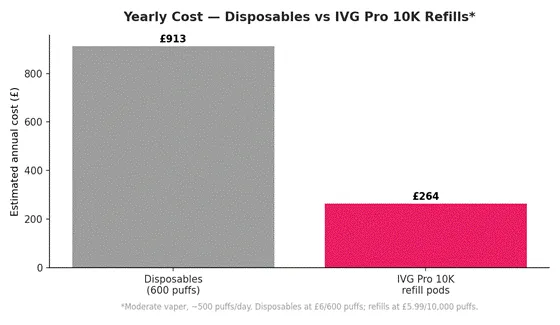
Estimated annual spend for a moderate vaper: old-format disposables versus IVG Pro 10K refill pods.
Cost Per Year: Where It Gets Serious
Per-puff figures are abstract, so let’s translate to a year of real use. Take a moderate vaper averaging 500 puffs a day — a fairly typical figure for someone who switched from 15-a-day smoking. On disposables, that habit consumed roughly 300 units a year: about £900 annually, often more once convenience-store pricing is factored in. On the refill system, the same year needs around 18 refill packs plus the one-off device: comfortably under £150 at multi-buy prices, and under £300 even paying full single-pack price every time. The saving lands somewhere between £600 and £750 a year for an average user — enough to matter to anyone, and transformative for heavy vapers who were burning through two disposables a day.
And that is before multi-buy economics. Because refill pods are a repeat purchase, most reputable UK retailers run three-for or five-for bundle pricing that pushes the per-pack cost down further, something that was never really viable with disposables.
The Environmental Ledger
The cost argument is compelling, but the waste argument is why disposables were banned in the first place. Before the ban, UK estimates put disposable vape disposal at millions of units per week, each containing a lithium cell, copper wiring, plastic and residual nicotine — a recycling nightmare that mostly ended up in general waste, where crushed lithium batteries cause bin-lorry and depot fires.
The refill model does not make vaping waste-free — you still discard a pod-and-container unit every ten thousand puffs — but it changes the ratio dramatically. One battery, recharged for months or years, replaces hundreds of discarded cells. One pod pack replaces roughly seventeen disposables’ worth of plastic housings and packaging. If our moderate vaper above generated 300 disposables of waste a year, the equivalent refill habit produces 18 pod packs and zero discarded batteries. Used pods should still go to a vape or small-electricals recycling point rather than household waste, but the footprint per puff is a fraction of what it was.
Convenience: What You Keep and What You Trade
The honest question for former disposable users is whether the refill format gives up any of the convenience they valued. Having lived with both, here is the fair accounting. What you keep: zero maintenance, since pods arrive prefilled and the coil is built in; instant flavour switching, because pods click in and out in seconds; and the same familiar inhale-activated, buttonless draw. What you gain: a battery display instead of the disposable’s mystery death, USB-C fast charging, and a choice of 20mg, 10mg or 0mg nicotine strengths across a range of around 39 flavours — a genuine step-down path disposables never offered.
What you trade: you must remember to charge one device (though a 1000mAh cell makes that a once-a-day-at-most habit), there is a small upfront device cost, and the two-part pod makes the unit slightly chunkier in the pocket than a slim disposable was. That is the entire downside list. For most people it is a trivially easy trade.
The Hidden Costs Nobody Counts
Sticker prices only tell part of the story, and the disposable era hid several costs that the refill model quietly eliminates. Wasted remainder was the biggest: disposables routinely died with liquid still inside when the battery gave out first, or wasted battery when the liquid ran dry — either way you paid for capacity you never used. The refill system decouples the two, so a pod is finished only when its liquid genuinely is. Convenience-store markup was another: disposables were an impulse product bought one at a time at whatever the petrol station charged, frequently a pound or two over online pricing, and nobody bulk-bought a product they would need three hundred of. Refills invert this — they are a planned repeat purchase, which is exactly the buying pattern multi-buy bundles and online pricing reward.
Then there is the emergency-purchase tax. Every disposable user knows the ritual of the device dying at 9pm and the overpriced replacement from whichever shop was still open. With a refill system, a spare pack in a drawer costs six pounds and removes the scenario entirely. None of these line items appears on a price comparison, but across a year they compound meaningfully — and every one of them falls on the disposable side of the ledger.
Five Ways to Cut the Cost Further
If you do switch, a few habits push the savings beyond the headline numbers. Buy in bundles — the three-for and five-for deals most UK retailers run cut per-pack cost by fifteen to twenty percent. Prime every pod properly, because a scorched coil that forces an early replacement is the most expensive mistake in the sealed-pod format. Draw gently; long hard pulls vaporise noticeably more liquid per puff for no extra satisfaction. Store spares sensibly, cool and upright, so a stockpile never degrades. And if reducing nicotine is your goal, step down strength gradually through the 10mg range rather than by vaping less of a 20mg pod — satisfied users consume less than unsatisfied ones, which is as true financially as it is behaviourally.
What About Refillable Bottle Kits?
Purists will point out that an open refillable pod kit with 10ml bottles of nic salt is cheaper still per millilitre, and they are right — if you are happy changing coils, carrying bottles, and troubleshooting leaks. The prefilled refill system deliberately occupies the middle ground: dramatically cheaper than disposables, dramatically simpler than open systems. It is the format for the majority of vapers who treated disposables as an appliance, not a hobby. If you have never wanted to know what a coil looks like, IVG Pro 10k refill pods are the format designed for you.
The Regulation Angle: Buying Future-Proof
There is a final argument for the refill format that has nothing to do with your wallet: regulatory durability. The disposables ban did not appear from nowhere — it was the product of years of pressure over waste and youth appeal, and anyone who stockpiled single-use vapes in spring 2025 was betting against a tide that had already turned. Refill systems like the IVG Pro were engineered for the post-ban rulebook from the ground up: a genuinely rechargeable and reusable device, a replaceable pod that satisfies the reusability requirements, a 2ml active tank that honours the TPD limit, and nicotine capped at the legal 20mg maximum. Choosing this format is not just cheaper; it is a purchase aligned with where UK policy is heading rather than where it has been.
That matters practically because further regulation is coming — vaping duty on e-liquid arrives in the near term, and flavour and packaging rules remain under review. Duty priced per millilitre will touch every format equally, but it makes waste even more expensive: liquid stranded in a dead disposable would have been taxed liquid thrown away. Formats that use every drop, backed by an established compliant manufacturer with the scale to adapt to new rules, are the safest place for a vaper to settle. IVG, as one of the UK’s largest and longest-standing brands, is about as sturdy a bet as the category offers.
Making the Switch: Practical Tips
If you are moving over from stockpiled disposables or another brand, three tips will smooth the transition. First, match your strength: if your disposable was 20mg nic salt — and almost all were — start with 20mg pods rather than assuming the bigger format needs less. Second, when you click a fresh pod and container together and slot them into the device, give the coil two to three minutes to saturate before the first draw; it is the single habit that prevents burnt-tasting pods. Third, buy two or three flavours in your first order — with each pack lasting one to three weeks, discovering you dislike a flavour on day two of a 12ml commitment is the format’s one genuine annoyance, and a spare pod solves it.
The Verdict
Run the numbers any way you like and the conclusion does not move. On cost, refills beat disposables by an order of magnitude — a typical user keeps £600 or more in their pocket every year. On waste, one rechargeable battery and a handful of pod packs replace a bin-load of dead lithium cells. On convenience, the refill format keeps effectively everything that made disposables popular and adds charging, capacity and strength options on top. The disposable era optimised for impulse purchase; the refill era optimises for the person actually using the product, and it is not a close contest.
For UK vapers ready to make the change, the full range of IVG Pro 10000 puffs is available from Pink Vape with multi-buy pricing and fast delivery across all the major flavours and strengths. As ever: these are age-restricted products for adults 18 and over, intended as an alternative for existing smokers and vapers — if you don’t use nicotine, don’t start.
