
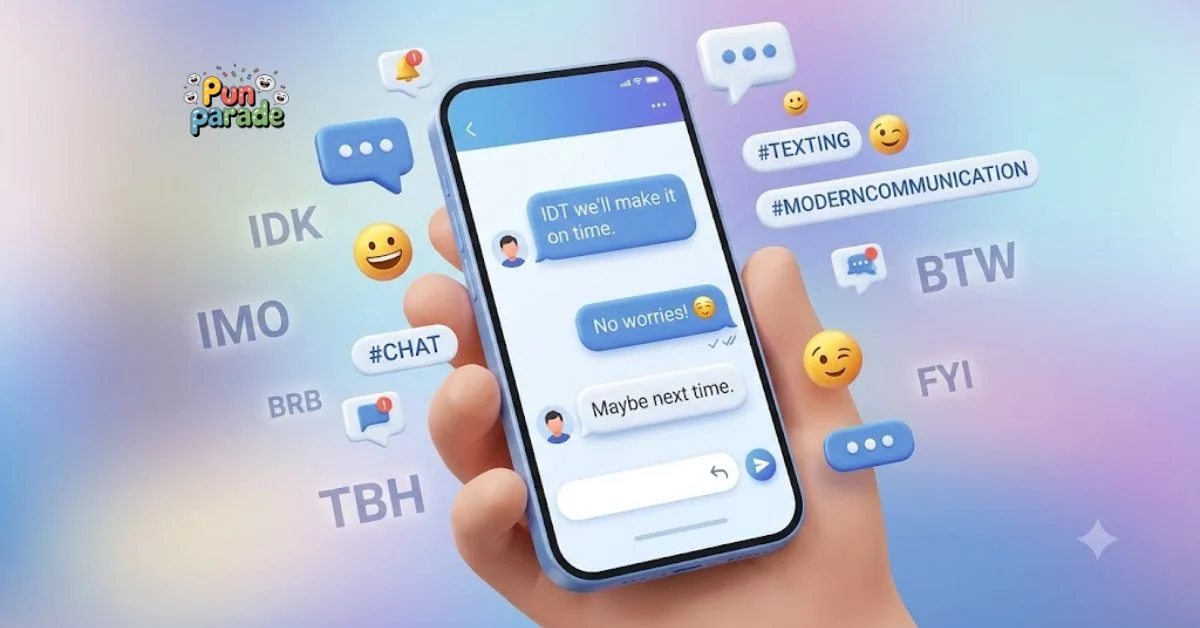
Have you ever received a message that simply said “IDT” and wondered what the sender meant? You’re not alone. Text abbreviations evolve quickly, and keeping up with modern slang can be challenging, especially when the same acronym has different meanings in different situations.
In most text messages, social media chats, and online conversations, IDT stands for “I Don’t Think.” It’s a quick way to express doubt, disagreement, or uncertainty without typing the full phrase.
Whether you’ve seen it on Snapchat, TikTok, Instagram, WhatsApp, or in a casual text, understanding the meaning behind IDT helps you avoid confusion and reply naturally. In this guide, you’ll learn what IDT means, where it came from, how people use it in everyday conversations, and when it’s appropriate—or inappropriate—to use.
IDT Meaning in Text – Quick Meaning
IDT most commonly means:
I Don’t Think
People use it when they want to politely disagree, express uncertainty, or share an opinion without sounding too direct.
Quick Facts
- Full form: I Don’t Think
- Tone: Casual
- Used on: Text messages, Snapchat, Instagram, TikTok, WhatsApp, Discord
- Common emotion: Doubt, hesitation, gentle disagreement, uncertainty
- Audience: Mostly teenagers, Gen Z, Millennials, and frequent internet users
Examples
“IDT that’s going to happen.”
“IDT she’s online right now.”
“IDT we should leave this early.”
Instead of writing an entire sentence, people shorten it to IDT because texting is all about speed and convenience.
Origin & Background
Unlike many internet slang terms that begin on a single platform, IDT developed naturally as part of the broader trend of shortening everyday phrases.
As texting became popular in the late 1990s and early 2000s, users began removing unnecessary words and vowels to type faster. Abbreviations like LOL, BRB, IMO, TBH, IDC, and IDK became common. IDT joined this family of shorthand expressions.
Its popularity increased as smartphones replaced traditional keyboards. Typing fewer characters became second nature, especially among younger users.
Social media platforms also helped spread IDT:
- Twitter encouraged shorter messages.
- Snapchat promoted quick conversations.
- TikTok comments favored brief responses.
- Instagram DMs made abbreviations feel more natural.
- Discord and gaming chats normalized internet shorthand.
Today, IDT is recognized by millions of internet users around the world, even though it remains more common in informal conversations than formal writing.
Related posts: I Hope You’re Having a Great Day: Meaning, Best Replies, and When to Use It
Real-Life Conversations
WhatsApp Conversation
Person A: Are you coming to dinner tonight?
Person B: IDT I can. My meeting is running late.
Person A: No worries. Maybe next time.
Instagram DM
Person A: Do you think that influencer edited the photo?
Person B: IDT. The lighting just looks really good.
TikTok Comments
Person A: This trend will still be popular next year.
Person B: IDT honestly. These trends disappear so fast.
Text Message
Person A: Should we buy the concert tickets today?
Person B: IDT we need to rush. They’re still available.
Person A: Okay, let’s wait until tomorrow.
Emotional & Psychological Meaning
Although IDT is only three letters long, it communicates more than simple disagreement.
Many people use it because it softens their opinion. Instead of saying:
“You’re wrong.”
They might say:
“IDT that’s correct.”
This small change makes the conversation feel less confrontational.
Psychologically, people often prefer softer language because it reduces conflict. Adding “I don’t think” signals that the opinion is personal rather than absolute.
For example, imagine your friend asks whether they’ll get accepted into a competitive university.
Instead of replying:
“No.”
You might say:
“IDT the results are out yet.”
The response sounds calmer, more supportive, and less harsh.
That’s one reason IDT has remained popular despite countless new slang terms appearing every year.
Another interesting aspect is emotional distance. People sometimes choose abbreviations because they feel less emotionally intense than writing full sentences. Saying “IDT” can make a disagreement feel lighter, especially in fast-paced online conversations.
Usage in Different Contexts
Social Media
IDT is extremely common in comments, captions, replies, and direct messages.
Example:
“IDT this challenge is safe.”
Friends & Relationships
Friends often use IDT to disagree politely.
Example:
“IDT he’s upset. I think he’s just tired.”
It keeps conversations friendly while allowing different opinions.
Work or Professional Settings
Using IDT at work depends on the situation.
If you’re chatting casually with close coworkers on an internal messaging platform, it may be acceptable.
Example:
“IDT the report is finished yet.”
However, in professional emails or client communications, it’s better to write the full phrase:
“I don’t think the report is complete yet.”
Using complete sentences demonstrates professionalism and avoids misunderstandings.
Casual vs. Serious Tone
Casual
- IDT you’re right.
- IDT it’s worth buying.
- IDT he’s coming.
Serious
In important discussions—such as legal matters, healthcare, academic work, or official communication—avoid abbreviations. Writing the complete phrase improves clarity and leaves less room for confusion.
When NOT to Use It
Even though IDT is widely understood online, there are situations where it’s better to avoid it.
Formal Emails
Business emails, job applications, and professional reports should use full sentences instead of text abbreviations.
Academic Writing
Teachers, professors, and examiners generally expect proper grammar rather than internet shorthand.
Conversations with Older Adults
Not everyone is familiar with texting slang. Writing “I don’t think” instead of “IDT” helps prevent confusion.
Sensitive Situations
If someone is discussing grief, illness, or another serious topic, abbreviations can feel dismissive. Using complete, thoughtful sentences shows greater empathy.
Cross-Cultural Communication
People from different countries may interpret IDT differently or not recognize it at all. When clarity matters, spell out the full phrase.
Common Misunderstandings
One reason IDT causes confusion is that it isn’t limited to texting. Depending on the context, it can represent completely different terms in medicine, business, education, and the military.
Some people also mistake it for similar abbreviations like IDK (“I don’t know”) or IDC (“I don’t care”), even though the meanings are quite different.
Another misunderstanding is tone. A short reply like “IDT” may seem cold or dismissive if there’s no additional context, while the sender may simply be expressing uncertainty rather than disagreement.
People also assume that everyone understands internet shorthand. In reality, many users—especially those who don’t spend much time on social media—may not recognize the abbreviation at all.
Finally, remember that IDT expresses an opinion, not a confirmed fact. Saying “IDT that’s true” means the speaker doubts something, not that they know it is false.
See Also: LMFAO Meaning: What It Really Means in Text, Social Media, and Everyday Chats
Comparison Table
| Expression | Full Meaning | Tone | Best Used When |
|---|---|---|---|
| IDT | I Don’t Think | Polite, uncertain | Expressing doubt or gentle disagreement |
| IDK | I Don’t Know | Neutral | You genuinely don’t know the answer |
| IDC | I Don’t Care | Indifferent | Showing a lack of concern (can sound rude) |
| IMO | In My Opinion | Respectful | Sharing a personal viewpoint |
| TBH | To Be Honest | Honest, direct | Giving a sincere opinion |
| IKR | I Know, Right? | Agreeable | Showing strong agreement |
| FR | For Real | Serious, emphatic | Confirming something is true |
| NGL | Not Gonna Lie | Candid | Introducing an honest statement |
Key Insight
Although these abbreviations all appear in casual online conversations, IDT is unique because it communicates uncertainty rather than certainty. It allows people to disagree without sounding overly harsh, making it one of the more polite pieces of texting slang.
Variations and Other Meanings of IDT
The meaning of IDT changes depending on the context. While “I Don’t Think” is the most common meaning in texting, the same abbreviation can represent different terms in other fields.
1. IDT Meaning in Text
Meaning: I Don’t Think
This is the most common internet meaning and is widely used in chats, texts, and social media.
Example:
“IDT we’ll finish before noon.”
2. IDT Meaning in Urdu
In Urdu, IDT is usually translated according to the sentence rather than literally.
Common translations include:
- مجھے نہیں لگتا
- میرا خیال نہیں ہے
- شاید ایسا نہ ہو
Example:
“IDT he’s coming.”
Urdu meaning:
مجھے نہیں لگتا کہ وہ آئے گا۔
3. IDT Meaning in Medical
In healthcare, IDT often stands for Interdisciplinary Team.
This refers to a group of healthcare professionals—such as doctors, nurses, therapists, and social workers—who work together to create and manage a patient’s care plan.
4. IDT Meaning in Business
In business settings, IDT can refer to Integrated Digital Technologies, Instructional Design Team, or another company-specific abbreviation.
Many organizations also create their own internal meaning for IDT, so the exact definition depends on the workplace.
5. IDT Meaning in School
Schools may use IDT for programs, departments, or educational teams.
For example, it may represent:
- Instructional Design Team
- Integrated Design Technology
- Individual Development Team
Students should always check their school’s handbook or ask a teacher if they’re unsure.
6. IDT Meaning in Company
Inside companies, IDT is often an internal department name, project title, or team abbreviation.
Its meaning varies by organization, so there isn’t one universal business definition.
7. IDT Meaning in Mental Health
Within mental health services, IDT commonly stands for Interdisciplinary Team.
This team may include:
- Psychologists
- Psychiatrists
- Counselors
- Nurses
- Occupational therapists
Together, they provide coordinated support for a person’s mental and emotional well-being.
8. IDT Meaning in the Army
In military contexts, particularly in the U.S. Armed Forces, IDT often means Inactive Duty Training.
This refers to scheduled training periods completed by Reserve or National Guard personnel outside of active-duty service.
9. IDT Meaning on Urban Dictionary
On Urban Dictionary and across internet slang communities, IDT is generally listed as “I Don’t Think.”
Users commonly employ it to express uncertainty, disagreement, or hesitation in online conversations.
10. IDT in Gaming and Online Communities
Gamers frequently use IDT during multiplayer matches and voice chats.
Examples:
“IDT we can win this round.”
“IDT that strategy will work.”
The abbreviation keeps communication fast without interrupting gameplay.
How to Respond When Someone Uses IDT
The best response depends on the conversation and the relationship you have with the other person.
Casual Replies
- “That’s fair.”
- “Maybe you’re right.”
- “We’ll find out soon.”
- “Let’s see what happens.”
Funny Replies
- “Only one way to find out!”
- “Challenge accepted!”
- “Now I’m even more curious.”
- “Let’s make a bet.”
Mature Replies
- “I understand your perspective.”
- “That’s a reasonable point.”
- “Let’s look at the facts first.”
- “I appreciate your honesty.”
Respectful Replies
- “Thanks for sharing your opinion.”
- “I respect that.”
- “You may be right.”
- “Let’s discuss it further.”
Regional & Cultural Usage
Western Culture
In countries like the United States, Canada, and the United Kingdom, IDT is a familiar texting abbreviation among younger internet users. It’s commonly seen in text messages, gaming chats, and social media comments.
Asian Culture
Many English-speaking internet users across Asia understand IDT, especially those active on TikTok, Instagram, and Discord. However, in everyday conversations, people often prefer spelling out the full phrase.
Middle Eastern Culture
IDT is recognized mainly by bilingual users who regularly communicate in English online. In Arabic-speaking communities, local abbreviations are often used instead.
Global Internet Usage
Because English dominates many online platforms, IDT has become part of international internet slang. Even users whose first language isn’t English often recognize its meaning after spending time on social media.
Gen Z vs. Millennials
Gen Z tends to use abbreviations like IDT naturally and frequently in chats, comments, and memes.
Millennials understand IDT but may use it less often, choosing complete sentences in many situations.
Older generations are generally less familiar with the abbreviation, making the full phrase a safer choice when communicating across age groups.
Read More: F2P Meaning: What It Really Means in Gaming, Texting, and Online Culture
Is IDT Safe for Kids?
Yes, IDT is generally safe for kids because it simply means “I Don’t Think” in most text conversations. It doesn’t contain offensive language or inappropriate content.
However, context still matters. Parents and educators should encourage children to understand internet abbreviations while also knowing when it’s better to use complete sentences, especially in schoolwork or formal communication. Teaching digital communication skills helps kids express themselves clearly and respectfully online.
Frequently Asked Questions
What does IDT mean in text?
In texting, IDT usually stands for “I Don’t Think.” It’s used to express doubt, uncertainty, or polite disagreement in casual conversations.
Is IDT the same as IDK?
No. IDT means “I Don’t Think,” while IDK means “I Don’t Know.” One expresses an opinion, and the other shows a lack of knowledge.
Is IDT rude?
Not usually. It’s often a polite way to disagree without sounding too direct. Tone and context determine how it’s received.
Can I use IDT in professional emails?
It’s better not to. Write “I don’t think” in full to maintain a professional and polished tone.
What is the Urdu meaning of IDT?
In most conversations, IDT translates to “مجھے نہیں لگتا” or “میرا خیال نہیں ہے,” depending on the sentence.
Does IDT have meanings outside texting?
Yes. In healthcare, it can mean Interdisciplinary Team, and in military contexts, it often stands for Inactive Duty Training. Businesses and schools may also use IDT as an internal abbreviation.
Is IDT commonly used on social media?
Yes. You’ll frequently see IDT on platforms like Instagram, TikTok, Snapchat, X, Discord, and WhatsApp, where people prefer quick, informal communication.
What does IDT mean in text?
IDT usually stands for “I Don’t Think.” It’s used in texting to express doubt, disagreement, or uncertainty in a casual way.
What does idi mean in text?
IDI has no widely accepted texting meaning and often depends on context. Sometimes it’s a typo for IDK or used as someone’s initials.
What is the full form of IDT in chat?
In online chats, IDT most commonly means “I Don’t Think.” It helps people reply quickly without typing the full phrase.
What does IDTS mean in text slang?
IDTS stands for “I Don’t Think So.” It’s a casual way to politely disagree or say that something is unlikely.
Conclusion
The meaning of IDT in text is simple once you understand the context. In most online conversations, it stands for “I Don’t Think,” making it a quick and friendly way to express doubt, disagreement, or uncertainty. Its popularity comes from the fast pace of digital communication, where short abbreviations save time without changing the intended message.
At the same time, it’s important to remember that IDT doesn’t always mean the same thing. In healthcare, business, education, mental health, and the military, it can represent entirely different terms. Looking at the conversation and the setting will usually reveal the correct meaning.
Whether you’re chatting with friends, replying to a social media comment, or trying to understand a message you’ve received, knowing how and when to use IDT helps you communicate more naturally and confidently. When in doubt—especially in professional or formal situations—writing out “I don’t think” in full is always the clearest choice.
